SEO Storytelling Mastery
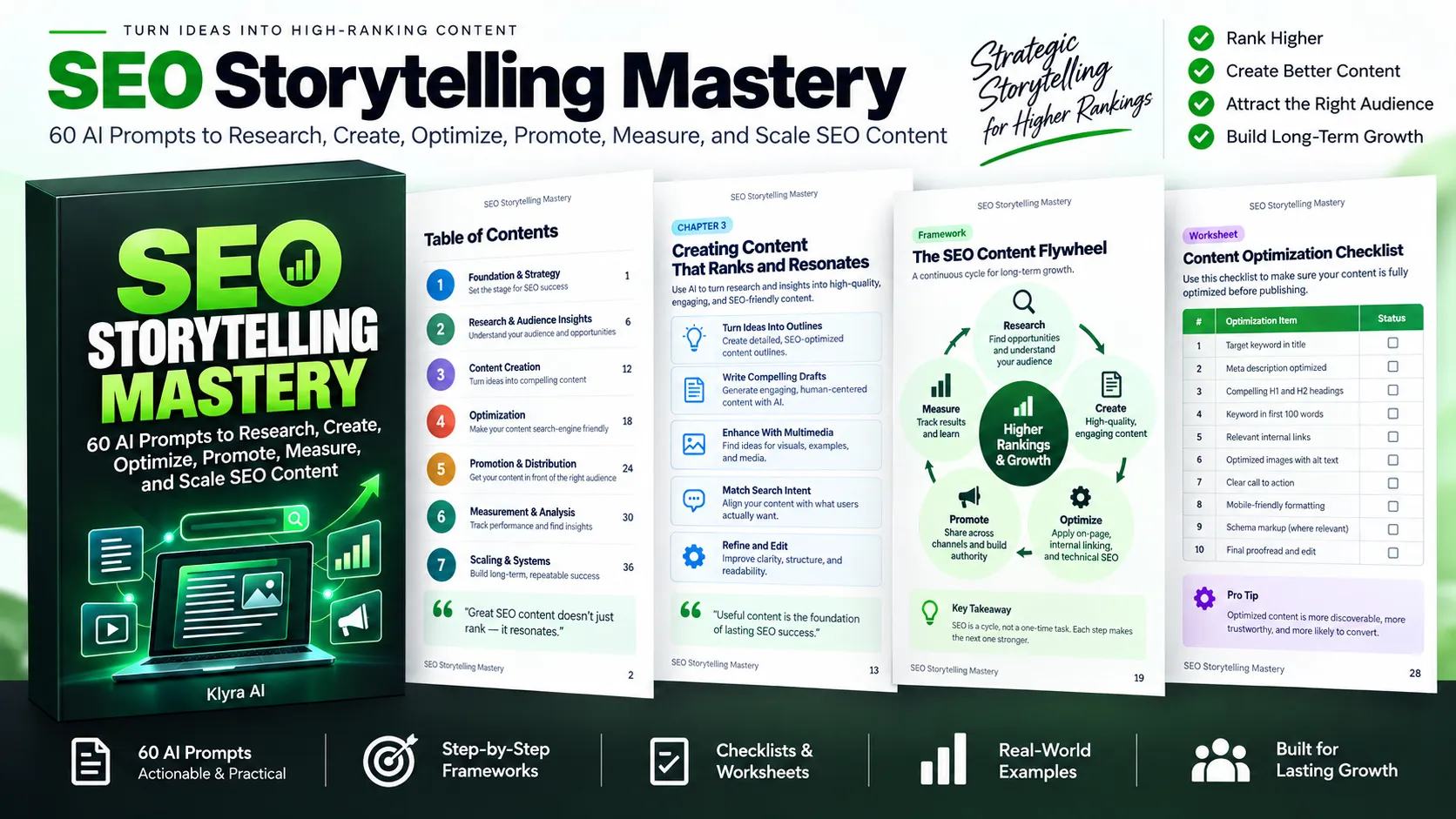
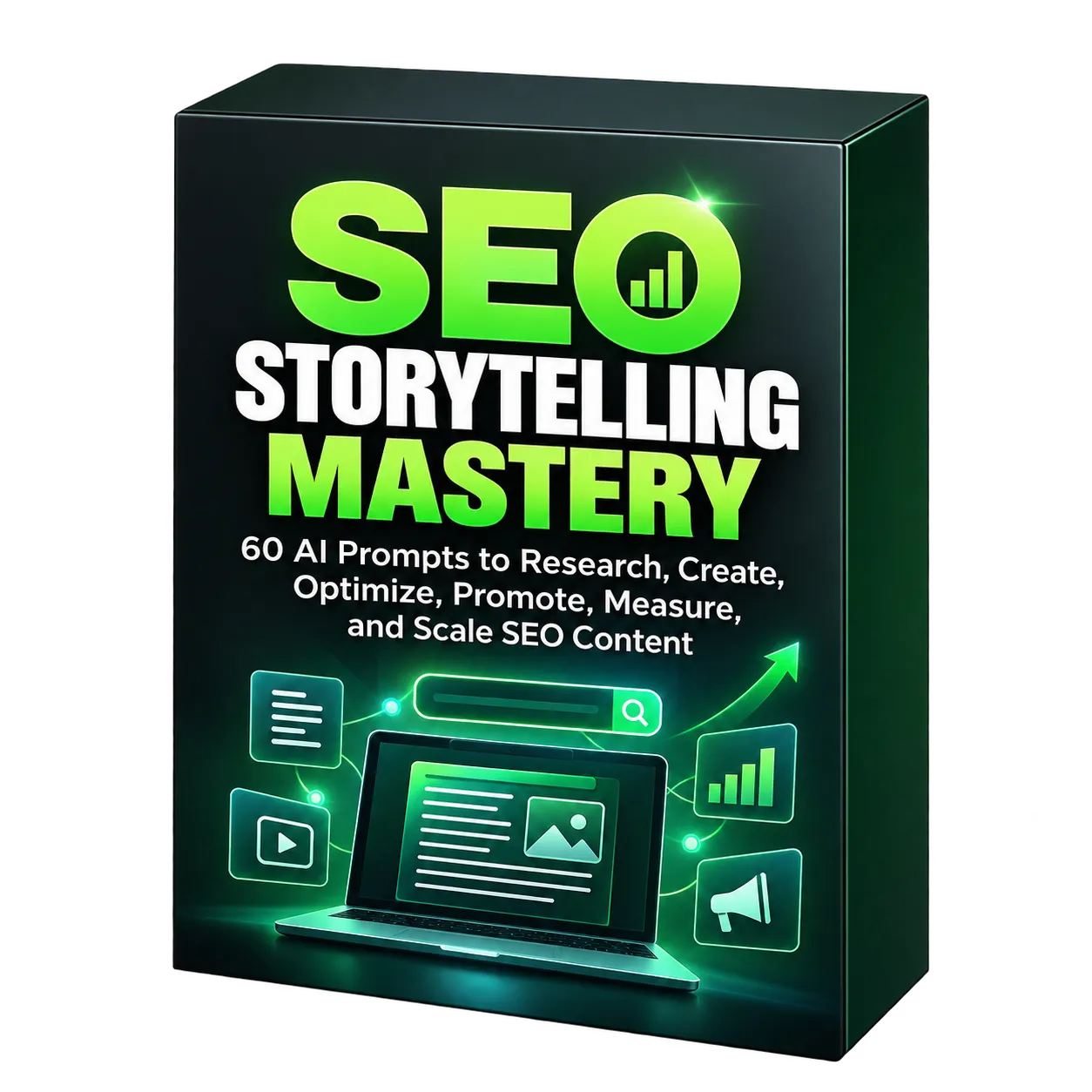
SEO Storytelling Mastery brings together 60 AI prompts designed to help you create content that satisfies both search engines and human readers.
The resource combines narrative storytelling with technical SEO and organizes the prompts into a complete content development and optimization system.
Understand Your Audience and Search Intent
Strong SEO content begins with understanding the people searching for information and the intent behind their searches.
Empathy Map Development
Create a comprehensive empathy map covering what the audience thinks, feels, says, and does. The prompt uses available audience research, customer feedback, and market data while identifying gaps that require additional research.
Customer Avatar Creation
Build a detailed customer avatar covering primary goals, obstacles, information triggers, and success metrics, then connect each attribute to content strategy and potential content angles.
Pain Point Identification
Analyze support tickets, reviews, or forum discussions to identify recurring audience pain points, their emotional drivers, how competitors address them, unique content angles, and associated keywords.
Audience Language Analysis
Extract the terminology, questions, objections, and success markers audiences use when discussing a topic. Turn these insights into a practical word bank for creating content that speaks the audience's language.
SERP Feature Analysis
Analyze search results for target keywords to identify dominant SERP features, what they reveal about user intent, content formats appearing in the results, and opportunities to gain search visibility.
Intent Signal Decoder
Classify keywords by primary and secondary search intent using query modifiers, competing content types, and SERP features. Then recommend an appropriate content format and structure.
SERP Emotional Subtext Analysis
Analyze the emotional triggers used by top-ranking content, including fear, aspiration, curiosity, and urgency, and identify ways to address similar motivations from a differentiated brand perspective.
Hybrid Intent Content Planning
Plan content for keywords with mixed informational and commercial or transactional intent, creating a structure that moves naturally between education and conversion-focused elements.
Develop Keyword Storylines and Content Architecture
The next stage connects keyword strategy with a broader narrative and content ecosystem.
Keyword Clustering Strategy
Group keywords according to semantic relationships and search intent, separating keywords that belong in one content piece from those that require dedicated pages.
Topic Cluster Creation
Develop pillar-and-cluster architectures with supporting content, search intent mapping, internal linking relationships, and primary and secondary keyword targets.
Content Cannibalization Detector
Identify overlapping content and keyword cannibalization issues, then determine whether affected pages should be merged, redirected, or refocused.
Funnel-Stage Keyword Mapping
Map keywords to awareness, consideration, and decision stages, then determine how different content formats can work together to guide readers through the customer journey.
Story Arc Matrix Development
Create narrative angles across different content formats while reinforcing core brand values and positioning.
Narrative Hook Creation
Generate different opening approaches using gaps, promises, statistics, questions, and controversial statements while naturally incorporating the primary keyword.
Brand Positioning Content Angle
Develop content angles that reinforce a brand's positioning and differentiate its approach from competitors.
Seasonal Content Planning
Create a 12-month content roadmap that aligns keyword targeting with seasonal trends and buying cycles, including publication timing, content refreshes, and quarterly themes.
Build Narrative-Optimized Content
Once the strategy is defined, the narrative architecture prompts help turn the strategy into engaging content.
Narrative-Optimized Page Blueprint
Create a detailed page blueprint covering the headline, lede, promise, body sections, proof elements, transitions, call to action, SEO considerations, section lengths, and keyword placement.
Micro-Scene Development
Create short narrative sections that maintain reader momentum while addressing different aspects of a topic using a problem-insight-resolution pattern, keyword integration, and transitions between sections.
Scannable Content Pattern
Transform dense content into a highly scannable format using strategic subheadings, bullet points, bold concepts, short paragraphs, and summary boxes while preserving narrative flow.
E-A-T Signal Enhancement
Strengthen expertise, authoritativeness, and trustworthiness by improving sourcing, credentials, experience, objection handling, and evidence while preserving the narrative quality of the content.
Integrate Keywords Without Sacrificing the Story
The keyword optimization prompts focus on improving topical depth while maintaining natural language and reader experience.
Semantic Keyword Integration
Identify natural placements for semantically related terms across headings, body content, image alt text, and specific sections.
Title Tag and Meta Description Creation
Create multiple title tags and meta descriptions that combine keyword relevance, emotional hooks, value propositions, and calls to action within specified length constraints.
Header Hierarchy Optimization
Improve heading structures using a single H1 aligned with search intent, logical H2 sections, and appropriate H3 subsections.
Skim-Scan-Settle Test
Evaluate whether headings communicate a coherent story, paragraph openings provide enough context, and individual sections work for deeper readers.
Optimize On-Page SEO and Technical Elements
Schema Markup Implementation
Identify suitable structured data and generate implementation-ready JSON-LD for relevant schema types such as Article, FAQ, HowTo, or Product.
Open Graph Tag Optimization
Create Open Graph and social sharing metadata while developing platform-friendly titles, descriptions, and image recommendations.
Mobile Metadata Audit
Review title tags and meta descriptions for mobile truncation and improve them while preserving keyword prominence and click-through potential.
Rich Snippet Opportunity Analysis
Analyze target keywords for rich-result opportunities, required schema types, necessary content changes, and implementation priorities.
Internal Linking Strategy
Design internal linking structures that distribute authority and create logical user pathways, including recommended source pages, destination pages, anchor text, and placement.
Multimedia Optimization Plan
Identify visual, video, and interactive opportunities that can improve engagement while defining technical requirements such as file names, alt text, captions, and transcripts.
Readability Enhancement
Identify sentence length, paragraph structure, passive voice, jargon, and flow problems, then improve readability while preserving the information and keywords.
Content Accessibility Audit
Review content for accessibility improvements involving image descriptions, heading structure, link text, color contrast, tables, video, audio, and other user experience considerations.
Distribute Content and Earn Links
Publishing content is only part of the process. The resource provides prompts for strategically distributing content and creating opportunities to earn relevant backlinks.
Multi-Channel Distribution Plan
Create a 30-day distribution strategy across owned, earned, and paid channels, including timing, content adaptations, KPIs, and funnel-stage considerations.
Community Seeding Strategy
Identify relevant communities and determine how to participate authentically, customize content angles, follow community guidelines, and choose appropriate timing.
Email Newsletter Adaptation
Transform published content into newsletter content with subject lines, personalized introductions, key takeaways, calls to action, and segmentation opportunities.
Social Platform Customization
Adapt core content for LinkedIn, Twitter, Instagram, and Facebook by considering platform-specific formats, messaging, timing, frequency, hashtags, and tagging.
Link-Worthy Content Enhancement
Identify improvements that could increase a piece's link-earning potential and determine why those additions may attract relevant publishers and outreach targets.
Give-Guide-Gain Outreach Template
Create helpful outreach emails using a give-guide-gain philosophy, including versions for cold outreach, warm connections, and follow-ups.
Link Target Prioritization
Prioritize outreach prospects using authority, topical relevance, traffic value, and estimated outreach success probability.
Resource Page Link Strategy
Identify resource page opportunities, develop search operators, evaluate prospect quality, create customized outreach angles, and improve content to increase acceptance potential.
Repurpose and Atomize Content
Strong cornerstone content can support multiple formats and channels.
Content Atomization Plan
Apply the resource's "rule of 8" to develop eight derivative assets from cornerstone content, prioritizing opportunities according to reach and resource efficiency.
Video Script Adaptation
Transform written content into a 3-5 minute video script with an early hook, visual cues, b-roll opportunities, graphics, calls to action, and video SEO recommendations.
Infographic Content Extraction
Extract the strongest concepts and data points from an article and organize them into an infographic structure with a keyword-focused title and SEO publishing recommendations.
Podcast Episode Outline
Transform written content into a podcast structure featuring a hook question, discussion segments, expert interview questions, listener takeaways, and promotional opportunities.
Measure and Optimize Content Performance
The measurement section turns content performance into an ongoing learning system.
Dashboard Development Specification
Design a content performance dashboard covering data sources, a North Star metric, funnel KPIs, visualization recommendations, and threshold-based alerts.
Content Audit Framework
Create a framework for scoring content across search visibility, engagement, conversion contribution, backlinks, social sharing, and freshness, then prioritize updates, consolidation, or retirement.
Attribution Model Comparison
Compare first-touch, last-touch, linear, time-decay, and data-driven attribution approaches to determine how content contributes to the customer journey.
Content Cohort Analysis Plan
Develop content-based visitor cohorts and analyze how visitors engaging with different content types progress through the funnel over time.
HTMI Testing Loop
Design a Hypothesis-Test-Measure-Iterate testing system for underperforming content, including hypotheses, expected impact, implementation, sample requirements, measurement, and ICE prioritization.
Title Tag Testing Strategy
Develop alternative title tags using different emotional hooks and create a structured approach for measuring their impact using Search Console data.
Content Freshness Update Plan
Create a structured plan for declining content covering outdated statistics, new topics, structural improvements, schema, technical updates, and the appropriate publication strategy.
Conversion Rate Optimization Audit
Identify conversion opportunities on content pages and connect each recommendation with implementation details, psychological principles, testing approaches, and quality-of-conversion metrics.
Scale Content Operations
The final group of prompts moves from individual content pieces to sustainable content operations.
Content Team Structure Design
Design an appropriate content team structure based on production volume, quality expectations, content types, responsibilities, hiring priorities, reporting relationships, costs, and phased scaling.
RACI Matrix Development
Create a Responsible, Accountable, Consulted, Informed framework covering the entire content workflow from ideation through measurement.
Editorial Calendar Automation
Design an automated editorial calendar connecting keyword research, planning, production, and performance measurement with workflow triggers, status tracking, reporting, reminders, and alerts.
Content Style Guide Development
Create a content style guide covering brand voice, SEO requirements, inclusive language, citation standards, formatting conventions, and quality benchmarks.
AI-Assisted Content Workflow
Build a human-in-the-loop workflow that determines which tasks AI should assist with, establishes quality guardrails, selects tools, trains AI and human editors, and measures the effectiveness of the hybrid process.
Content QA Process Design
Develop a three-stage content review process covering narrative, SEO, and proofreading, with standardized checklists, responsibilities, time allocations, exception handling, and continuous learning.
Content Velocity Optimization
Analyze the workflow from brief to publication and identify ways to reduce production time while maintaining or improving quality.
Template Development Strategy
Identify high-value reusable templates that improve production efficiency while embedding SEO best practices, narrative quality, customization variables, and implementation guidance.
Implementation Strategy
The resource recommends using the prompts as a sequential system rather than isolated commands.
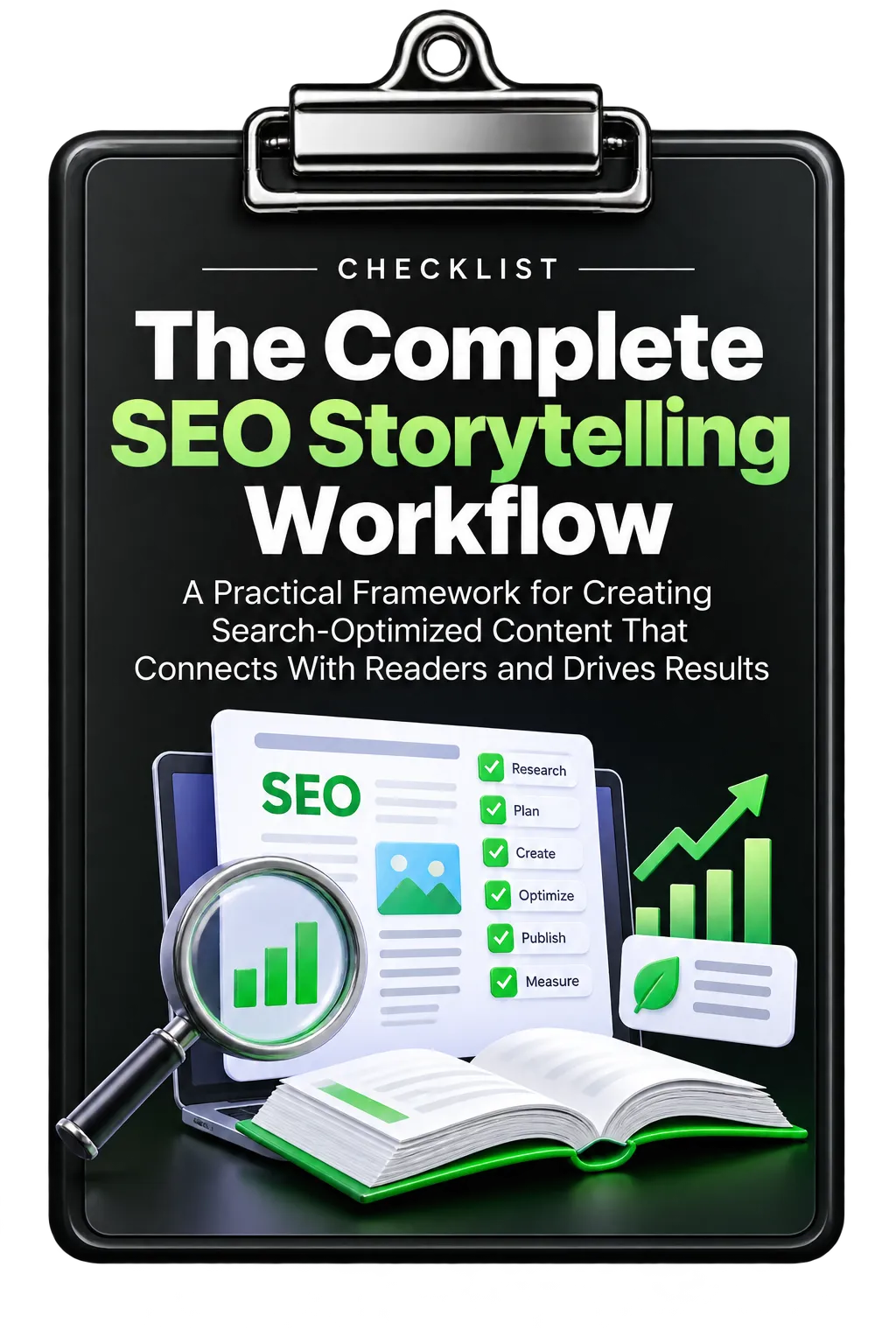
- Start with Audience Understanding: Begin by understanding who the content is for and what they are searching for.
- Research: Use audience mapping and keyword research prompts to gather insights.
- Planning: Apply keyword clustering and narrative angle prompts to organize the content strategy.
- Creation: Use narrative architecture and on-page SEO prompts to build optimized content.
- Distribution: Apply distribution and link-earning prompts to amplify reach.
- Measurement: Track content performance using the measurement prompts.
- Optimization: Use testing and improvement prompts to refine content.
- Scaling: Apply team and workflow prompts to build sustainable content systems.
The implementation framework is explicitly designed to follow the content development process from research through scaling.
Customize the Prompts
The resource recommends customizing prompts with specific information about the industry, audience, brand, competitors, existing performance data, and business goals.
- Audience characteristics and pain points
- Brand positioning and values
- Competitive landscape insights
- Performance data from existing content
- Business goals and KPIs
The more relevant context provided to the AI assistant, the more useful and actionable the resulting output can be.
Create Continuous Learning Cycles
The prompts are designed to work together as a feedback loop. Insights from SERP analysis can improve keyword clustering, performance measurement can inform new testing hypotheses, and distribution results can improve future content repurposing decisions.
Keep Humans in the Loop
The resource recommends combining AI assistance with human expertise rather than treating AI output as the final decision-maker.
- Use AI for data analysis, pattern recognition, and generating options.
- Use human expertise for strategic decisions and creative differentiation.
- Use human review for quality control, brand voice, and final judgment.
This human-in-the-loop approach allows AI to accelerate production while humans maintain quality and brand consistency.
Build Systems for Scale
As the content operation matures, the resource recommends systematizing successful approaches through customized prompts, standard operating procedures, documented prompt patterns, team training, and quality benchmarks.
The overall objective is a content engine that combines compelling storytelling with the technical optimization required for search visibility while serving both search engines and human readers.