Before You Add a Chatbot, Start With the Problem
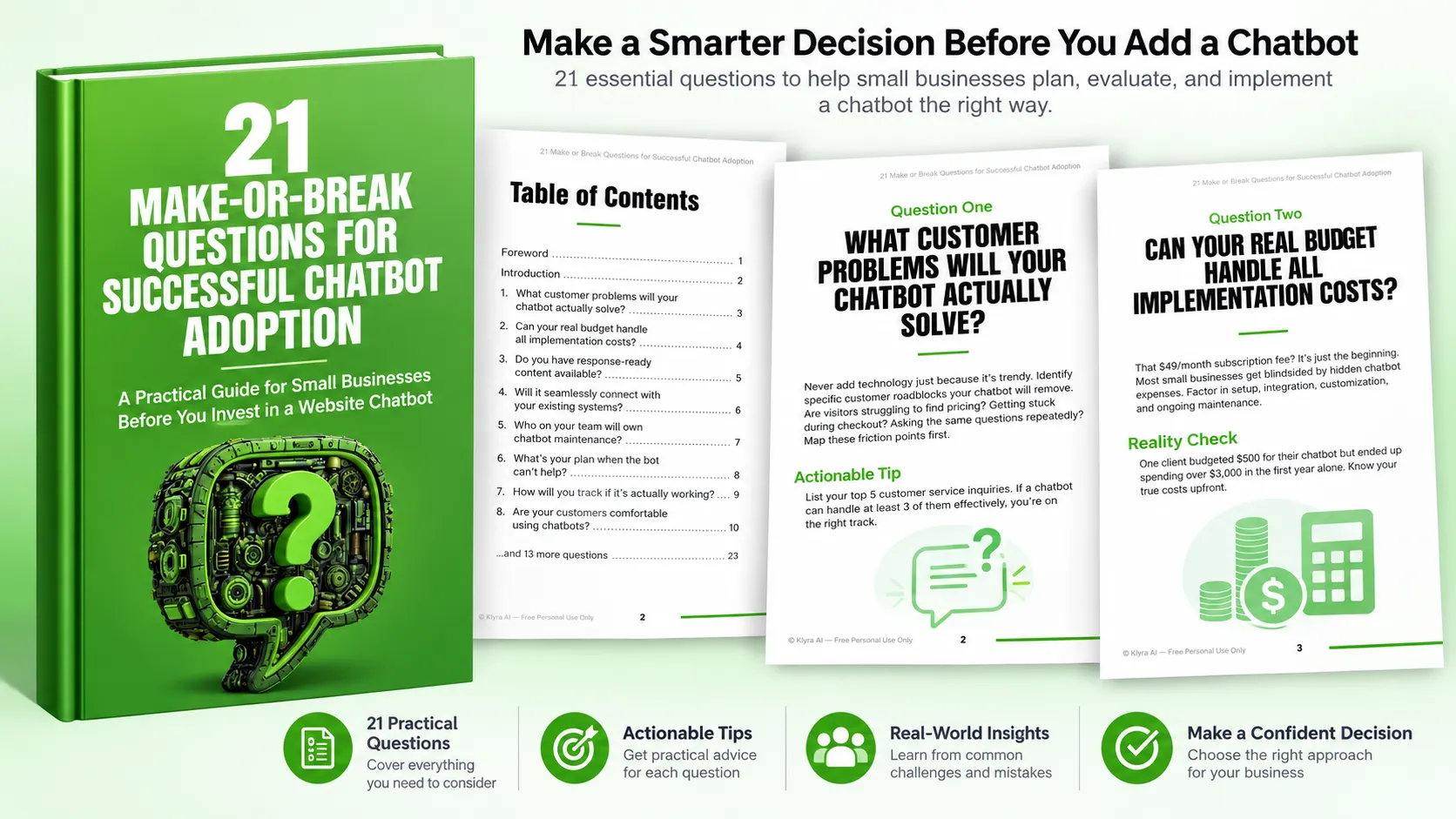
Adding a chatbot to a small business website should begin with the customer problem, not the technology. The resource opens with a simple principle: identify the specific roadblocks a chatbot is expected to remove.
Customers may struggle to find pricing information, get stuck during checkout, or repeatedly ask the same questions. Mapping these friction points first helps determine whether a chatbot has a meaningful role to play.
A useful starting exercise is to list the top five customer service inquiries your business receives. The resource suggests that if a chatbot can effectively handle at least three of them, there may be a strong case for moving forward.
Understand the Real Cost of Chatbot Adoption
The subscription price of a chatbot does not necessarily represent the full investment. The resource encourages businesses to consider setup, integration, customization, and ongoing maintenance before making a decision.
One example in the guide describes a client who budgeted $500 for a chatbot but spent more than $3,000 during the first year. The broader lesson is to understand the complete cost upfront rather than evaluating a chatbot based only on its advertised subscription price.
Prepare the Information Your Chatbot Needs
A chatbot needs useful information to provide useful answers. Before implementation, businesses should consider whether they already have comprehensive FAQs, product information, and explanations of important processes.
The resource provides a simple test: try explaining the answers to your most common customer questions using clear, concise sentences. If those answers are difficult to explain, the chatbot may struggle to communicate them effectively as well.
Check Integration and Assign Ownership
A chatbot should not become an isolated source of information. Before choosing a solution, verify whether it can connect with the systems your business already relies on, such as a CRM, e-commerce platform, or scheduling tools.
The guide gives particular attention to connecting the chatbot with customer information because this can support more personalized interactions.
Ownership is equally important. Someone should be responsible for monitoring, updating, and improving the chatbot. The resource recommends scheduling weekly 30-minute review sessions to analyze conversations and update responses.
Plan for the Moments When the Chatbot Cannot Help
Even capable chatbots have limits. A successful implementation needs a clear process for moving conversations from automated support to human assistance when necessary.
The guide recommends recognizing signals such as a customer asking to speak to a human or repeatedly asking the same question. These situations can indicate that automated assistance is not resolving the customer's need.
Handling frustrated customers also requires deliberate planning. Chatbots should recognize emotional or negative language and provide a quick path to human assistance rather than continuing with a rigid scripted response.
Define How You Will Measure Success
Chatbot adoption needs measurable objectives. Instead of relying on vague expectations, the resource recommends tracking indicators such as customer satisfaction scores, conversion rates, response times, and support ticket reduction.
It also recommends comparing metrics from before implementation with results after implementation. Monthly reporting can help identify trends rather than relying on individual snapshots.
Consider Your Customers and Your Brand
A chatbot may be technically suitable while still being a poor fit for your audience. Consider whether your customers are comfortable using chatbots and whether their preferences align with automated support.
The resource suggests using a short customer survey to understand whether customers prefer chat support, phone calls, or email.
Chatbot personality is another consideration. The guide recommends deciding whether the conversational approach should be professional, friendly, humorous, or compassionate. Writing sample responses in different styles can help a team identify which approach best represents the brand.
Evaluate Data, Product Complexity, and Website Placement
If a chatbot will handle personal data, payment details, or health information, the resource emphasizes the importance of verifying compliance with relevant regulations, including GDPR, HIPAA, and PCI. Clear disclosures about collected information and how it is protected can also help establish customer confidence.
Product complexity matters too. Simple products may be easier for a chatbot to explain, while highly customized offerings can require more nuanced explanations. The guide suggests testing whether the benefits of your product can be explained in under 30 seconds.
Not every website page necessarily needs chatbot assistance. The resource recommends identifying high-value pages, including product pages, pricing sections, and checkout processes. It specifically suggests looking at pages with high traffic and high abandonment as potential starting points.
Prepare for Language and Traffic Requirements
Businesses serving multilingual audiences need to consider the languages their customers actually use. The resource recommends checking analytics for visitor language preferences and notes that machine translation can sometimes fail to capture important nuance.
Performance during busy periods is another consideration. A chatbot that fails during a major traffic surge can create a poor customer experience. Businesses should ask providers about uptime during traffic spikes and whether response times are supported during periods of high demand.
Test Before You Go Live
Testing should happen before customers depend on the chatbot. The guide recommends structured testing involving team members and a small customer group so potential problems can be identified and corrected.
Its testing approach suggests creating 15 to 20 scenarios representing common customer journeys and testing each multiple times. Testing should also include deliberate attempts to confuse the chatbot so weaknesses can be discovered before launch.
Learn From Competitors and Plan for Improvement
Competitor chatbots can provide useful lessons. The resource recommends spending time interacting with similar businesses' chatbots and noting what works, what does not, and where a better customer experience could be created.
It also asks how the chatbot will improve over time. Different platforms may rely on decision trees, manual updates, or AI that learns from interactions. Understanding what maintenance and input the system requires is particularly important for small teams.
Make Sure a Chatbot Is Actually the Best Solution
One of the guide's most important questions is whether a simpler solution could solve the same customer problem. A chatbot is not automatically the best answer.
Depending on the problem, an improved FAQ page, better website navigation, or targeted how-to videos may provide a more effective or affordable solution. The resource recommends listing three non-chatbot alternatives and comparing their implementation costs and potential effectiveness.
If a chatbot is still the right choice, clearly define the unique value it will provide. The guide suggests completing the statement: “Our chatbot will be the only one in our industry that helps customers _______.” If the value cannot be clearly defined, the approach may need to be reconsidered.
Introduce the Chatbot Properly
Launching a chatbot without explaining it to customers can create confusion. The resource recommends an introduction plan that explains what the chatbot can help with, acknowledges its limitations, and makes clear how customers can get human help when needed.
Transparency about automation can help customers understand what to expect from the experience.
A More Thoughtful Approach to Chatbot Adoption
The 21 questions are designed to help small businesses evaluate chatbot adoption before committing to implementation. The central idea is straightforward: the objective is not to add technology simply because it is available. The objective is to solve real customer problems and support the business.
Before moving forward, work through the questions honestly, starting with the customer problems, budget, and available content. Then evaluate integration, ownership, escalation, measurement, audience fit, security, testing, alternatives, and the chatbot's long-term value.
The complete resource provides all 21 questions and their practical exercises in one place, making it useful as a reference while evaluating or preparing a chatbot implementation.