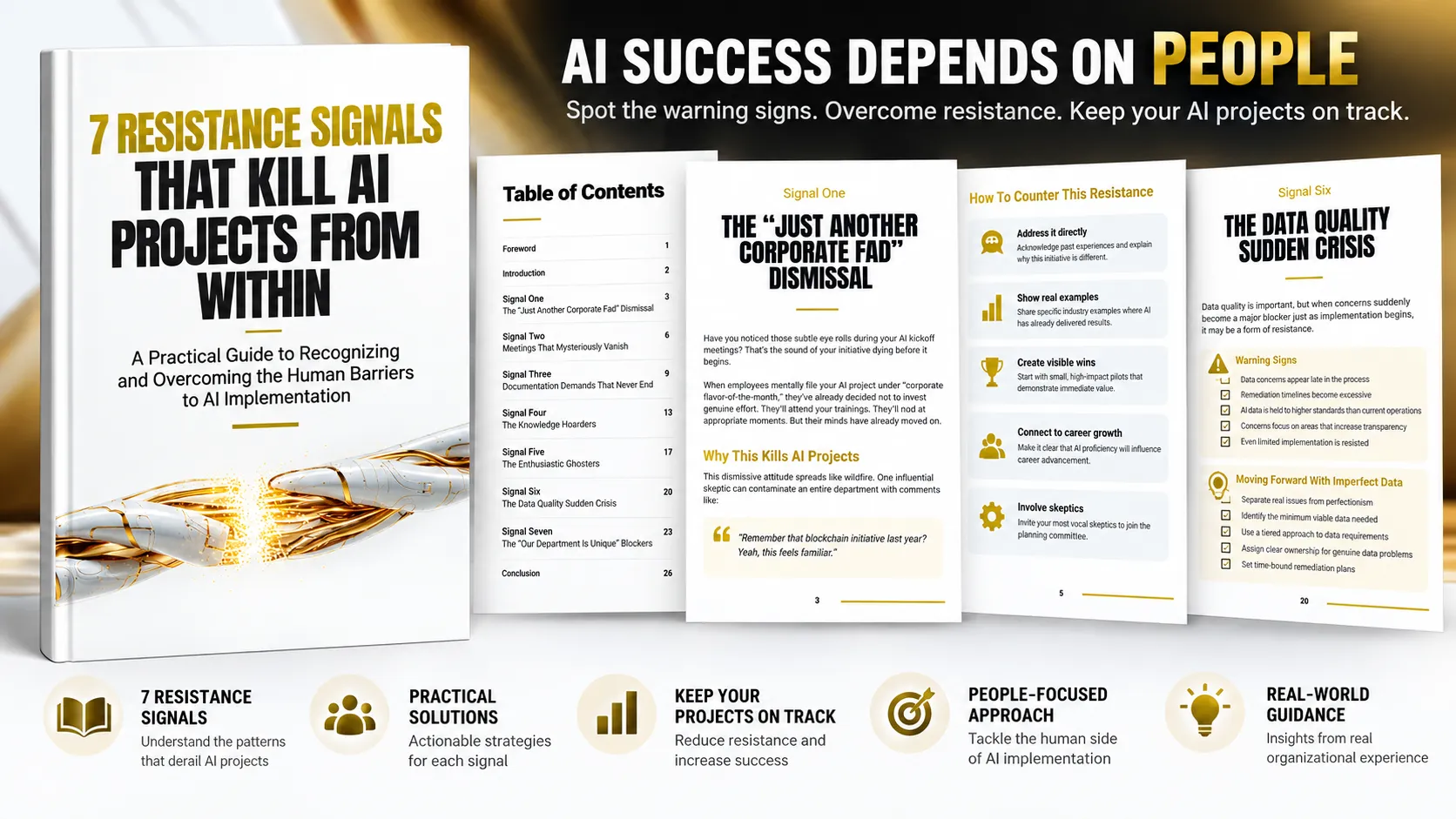
The Human Side of AI Implementation
AI implementation is not only a technology challenge. This resource argues that organizational resistance can quietly undermine technically sound AI initiatives. Resistance does not always appear as an explicit refusal to participate. It can hide behind polite agreement, procedural delays, excessive caution, missed commitments, and other behaviors that make progress increasingly difficult.
The guide identifies seven resistance signals that can threaten an AI initiative from within. Each signal is presented as a recognizable pattern, followed by warning signs and practical approaches for addressing it.
1. The "Just Another Corporate Fad" Dismissal
Some employees may treat an AI initiative as another temporary corporate program. They attend training and meetings but remain mentally disengaged because they expect the organization to move on to its next priority.
What to Watch For
- Minimal note-taking during sessions.
- Few or no follow-up questions.
- Conversations quickly moving to unrelated topics after training.
- References to previous initiatives that were abandoned.
How to Respond
Address the skepticism directly, explain why the initiative is different, and demonstrate value through small, high-impact pilots. The resource also recommends connecting AI proficiency with career development and involving vocal skeptics in planning so their concerns can strengthen the implementation rather than undermine it.
2. Meetings That Mysteriously Vanish
Repeatedly postponed AI implementation meetings can signal passive resistance. Although scheduling conflicts may appear harmless individually, persistent postponements can gradually communicate that the initiative is not a priority and erode momentum.
How to Respond
Make attendance and participation visible through simple tracking. Executive sponsors should clearly establish the importance of implementation meetings. The resource also recommends shorter, focused meetings, clear rules about which stakeholders must attend personally, and appropriate consequences when persistent absence creates project dependencies.
3. Documentation Demands That Never End
Thorough documentation can be valuable, but repeated requests for increasingly detailed specifications can become a mechanism for delaying action. The warning sign is not documentation itself, but documentation requirements that continually expand without helping decisions move forward.
How to Respond
Establish documentation standards for each project phase before work begins. A documentation decision tree can help determine what information is genuinely necessary. Time-boxing documentation work, communicating the cost of delay, and involving persistent requesters in producing the requested materials can also help prevent documentation from becoming a substitute for implementation.
4. The Knowledge Hoarders
Subject matter experts possess valuable knowledge, but some may withhold the deeper insights needed to make an AI implementation effective. The resource connects this behavior to fears about obsolescence and the possibility that AI could threaten the value associated with specialized expertise.
Recognizing Knowledge Hoarding
- Vague answers to specific knowledge-extraction questions.
- Excessive emphasis on exceptions and edge cases.
- Routine processes described as unusually complex or judgment-based.
- Outdated information provided instead of current practices.
- Reluctance to document tacit knowledge or decision-making frameworks.
How to Respond
Create a safe environment for discussing concerns about changing roles. Reframe knowledge sharing as career evolution and use multiple methods to capture tacit knowledge, including process observation, think-aloud protocols, and scenario-based workshops. Cross-functional validation and new status opportunities for effective knowledge sharers can further encourage participation.
5. The Enthusiastic Ghosters
Not all resistance sounds negative. Some participants express strong support for an AI initiative while consistently failing to complete the work they agree to do. This creates a gap between verbal commitment and actual implementation.
Spotting the Say-Do Gap
- Repeated enthusiasm accompanied by minimal results.
- Assignments accepted but rarely completed.
- Progress reports that sound positive without concrete accomplishments.
- Departments expressing support without operational changes.
- Repeated "almost done" updates without delivery.
How to Respond
Create visibility around actual progress through specific milestone tracking. Smaller and more frequent deliverables can expose delays earlier than large, distant deadlines. Clear accountability, paired responsibility for critical tasks, and direct feedback conversations can help close the gap between stated support and meaningful action.
6. The Data Quality Sudden Crisis
Data quality is a legitimate consideration for AI implementation. The resistance signal appears when concerns about data suddenly become a major blocker just as implementation begins, particularly when the same data was previously considered adequate for operational decision-making.
Warning Signs
- Data concerns appear late after earlier approvals.
- Remediation timelines become excessive or open-ended.
- AI data is held to substantially higher standards than current operations.
- Concerns focus on areas that would increase performance transparency.
- Even limited implementation is resisted where data-quality issues are already acknowledged.
Moving Forward With Imperfect Data
The resource recommends separating legitimate data concerns from perfectionism. A tiered approach can distinguish critical data from areas where reasonable approximations are acceptable. A minimum viable data approach can then identify the smallest dataset required for meaningful initial implementation, while genuine data problems receive specific owners and time-bound remediation plans.
7. The "Our Department Is Unique" Blockers
Some departments repeatedly argue that standardized AI approaches cannot apply to them because their operations are different. Legitimate differences may require customization, but broad uniqueness claims can also create unnecessary fragmentation and technical complexity.
Recognizing Special Pleading
- Minor operational differences are presented as barriers to standardization.
- Solutions working in comparable departments are rejected.
- Custom development is requested despite the resulting complexity.
- Legacy systems are retained "just in case."
- Claims are made that stakeholders or customers would not accept AI-driven approaches.
Balancing Flexibility With Standards
Start by acknowledging legitimate customization needs while maintaining a clear expectation that implementation will proceed. A structured exception process can require departments to document specific operational impacts rather than relying on general claims of uniqueness. Small pilot tests can also be used to verify whether claimed barriers actually occur in practice.
Peer examples and phased implementation can help resistant departments adapt. Beginning with less controversial use cases can establish successful examples before moving into more difficult areas.
Recognizing Resistance Before Momentum Is Lost
The seven patterns share an important characteristic: resistance may be difficult to identify when leaders look only for explicit opposition. A team can appear supportive while disengaging, delaying, withholding information, avoiding accountability, or creating procedural barriers.
The resource therefore emphasizes observation of behavior rather than relying solely on stated attitudes. Warning signs include declining participation, repeated delays, constantly expanding requirements, gaps between commitments and delivery, sudden objections, and requests for special treatment.
Turning Resistance Into Action
The countermeasures throughout the guide follow a practical approach: make resistance visible, create accountability, reduce indefinite delays, involve the people raising concerns, and test assumptions through focused implementation.
Several recurring approaches include:
- Make hidden patterns visible through tracking and concrete milestones.
- Use small, high-impact pilots to demonstrate tangible value.
- Set clear standards and time limits for activities that could otherwise delay implementation.
- Address fears and concerns directly rather than treating resistance as simple noncompliance.
- Give subject matter experts meaningful ways to contribute and evolve their roles.
- Separate legitimate operational concerns from tactics that unnecessarily block progress.
- Use practical evidence and pilot tests to challenge assumptions about what can or cannot work.
The Central Lesson
The guide concludes that successful AI initiatives depend heavily on how effectively organizations manage the human side of implementation. The most advanced technology does not automatically overcome organizational resistance.
The seven resistance signals provide a way to identify hidden barriers before they become larger implementation problems. The practical response is to recognize the pattern early, understand what is driving it, and apply an appropriate countermeasure while momentum can still be maintained.
The resource's final challenge is straightforward: identify which resistance pattern is currently threatening your AI implementation and address it before progress is lost.