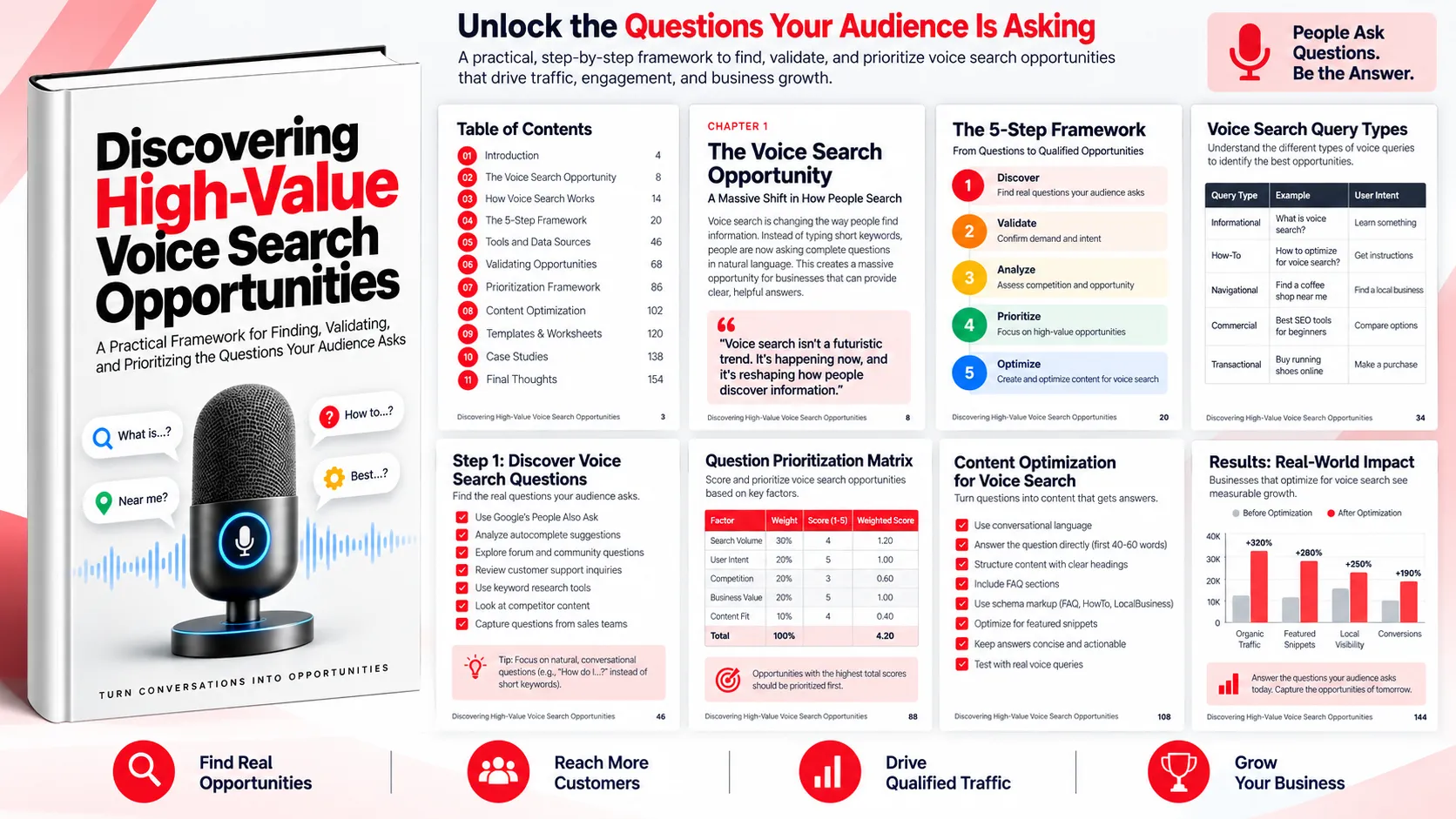
Build a Voice Search Strategy Around Real Questions
Voice search changes the way people express their information needs. Instead of relying only on short keyword phrases, users can ask complete questions using natural language. This makes understanding the actual questions an audience asks an important part of voice search research.
The Discovering High-Value Voice Search Opportunities guide provides a four-stage process for finding those questions, expanding the initial list, validating potential opportunities, and deciding which questions deserve attention first.
The central idea is straightforward: do not try to optimize for every possible question. Build your strategy around the questions that matter most to the business and its audience.
Stage 1: Mine Authentic Customer Language
The foundation of effective question research is real customer language. Rather than beginning with assumptions about what people might ask, collect questions from conversations and interactions that already exist.
Where to Find Real Customer Questions
- Customer service tickets and chat logs
- Sales call transcripts
- Email inquiries
- Social media comments and messages
- Review comments
- Forum discussions
- Help desk tickets
The guide recommends turning these sources into a structured question inventory. A practical starting exercise is to export three months of customer service data and create a spreadsheet containing the original question, question category, intent type, and frequency count.
Capture the Way People Actually Speak
Written questions do not always reflect how people naturally speak. The guide therefore recommends actively capturing voice-first phrasing through techniques such as dictating questions with voice-to-text, transcribing customer calls with permission, asking team members to speak questions aloud, and comparing typed versions with spoken versions.
Pay particular attention to recurring phrasing and vocabulary. These patterns can reveal how customers naturally frame their problems and information needs.
Stage 2: Expand Your Question Universe
Once you have an initial seed list, expand it systematically rather than relying on a small collection of obvious questions.
Use People Also Ask to Discover Related Questions
Google's People Also Ask results can be used to uncover relationships between questions. Enter a seed question, expand multiple PAA results, document the related questions, and note how the questions connect to one another.
This process can reveal a progression from a primary question to related and follow-up questions. For example, a question about fixing a leaky faucet can lead to questions about what causes the leak, whether it can be fixed independently, what tools are required, when professional help is needed, and the cost of repair.
Use AI to Generate Variations
AI tools can also help expand a question inventory. The guide suggests asking an AI tool to generate different ways someone might ask about a topic using voice search and to identify follow-up questions that could arise after learning about that topic.
AI-generated questions should not replace real customer language. Instead, compare generated variations with authentic customer questions and use the comparison to identify natural conversational patterns.
Recognize Common Voice Search Patterns
Look for question starters such as how, why, what, where, when, and who. Other patterns include conversational phrases, location modifiers such as "near me," time-based queries such as "open now," and comparison questions such as "what's better" or "which is best for."
Stage 3: Validate Questions With Search Data
A large question inventory still needs validation. The guide recommends using Google Search Console to identify and evaluate question-based queries already associated with search visibility.
Create a Question Tracking System
Search Console can be filtered for queries containing question words, queries ending in question marks, and queries beginning with terms such as "can," "should," or "will."
Create a tracking spreadsheet containing:
- Question
- Monthly impressions
- Average position
- Click-through rate
- Featured snippet presence
For each question, also consider monthly impression volume, current ranking position, click-through rate, featured snippet presence, and voice search appearance through manual testing.
Use Proxy Metrics for Voice Search Potential
Because direct voice search volume data is limited, the guide recommends using proxy indicators to assess potential. These include mobile search impression share, local intent signals, featured snippet presence, frequency of "near me" modifications, and question-format query volume.
Prioritize Based on Search Performance
The guide provides a question performance matrix to help organize opportunities. Questions with higher impression levels but weak rankings can receive greater attention, while questions already performing strongly with featured snippets can be monitored or defended. Lower-volume questions can receive lower priority.
Stage 4: Prioritize Commercially Valuable Questions
Search visibility alone does not determine which questions deserve investment. The next step is assessing the commercial value of each opportunity.
Score Commercial Value
The guide recommends scoring each question from 1 to 5 across five dimensions:
- Purchase intent indicators
- Service alignment
- Customer lifetime value potential
- Conversion probability
- Competition level
These scores are combined into a total score out of 25. This creates a structured way to compare questions instead of prioritizing them based only on intuition or search volume.
Analyze the Competition Gap
For high-scoring questions, review the current search landscape. Analyze the existing featured snippet when one is present, review the top five ranking pages, identify content gaps, assess answer quality, and note multimedia content.
The guide identifies several potential competition gaps, including situations where there is no clear featured snippet, existing answers lack depth, few competitors use structured data, multimedia content is limited, or mobile optimization is poor.
Build Question Clusters
Related questions should be organized into topic clusters rather than treated as isolated opportunities.
The process is to identify primary pillar questions, group supporting questions, map the user's journey, and note logical connections between pieces of content.
A single primary question can therefore become the center of a broader question cluster. Supporting questions can address causes, tools, timing, costs, alternatives, or other related information needs.
Question clustering creates a more organized roadmap for developing content around connected search needs.
Put the Research Into a 30-Day Process
The guide provides a four-week implementation plan for moving from raw customer language to prioritized content opportunities.
Week 1: Build the Foundation
- Export customer service data.
- Create the question tracking spreadsheet.
- Identify the top 10 seed questions.
Week 2: Expand the Inventory
- Expand questions using People Also Ask.
- Generate AI-assisted question variations.
- Begin tracking questions in Search Console.
Week 3: Validate and Analyze
- Score commercial value.
- Analyze competition.
- Create initial question clusters.
Week 4: Turn Opportunities Into Content Priorities
- Prioritize the strongest opportunities.
- Create content briefs.
- Begin answer optimization.
Measure the Results
The guide recommends tracking several indicators to understand whether the voice search strategy is producing useful outcomes:
- Featured snippet capture rate
- Voice search appearance frequency
- Question-driven conversions
- Answer impression share
- Snippet stability duration
These measures provide a way to evaluate visibility and outcomes associated with the questions being targeted.
Overcome Common Research Challenges
Limited Customer Data
When customer data is limited, the guide recommends using competitor Q&A sections, industry forums, social media discussions, customer surveys, and manual voice-query testing to expand the research base.
Unclear Question Volume
When absolute search volume does not provide enough information, focus on trend data, use multiple proxy metrics, account for seasonal variations, and monitor competitive rankings.
Limited Resources
When there are more opportunities than available resources, start with questions that have higher commercial value, clear competition gaps, existing traffic, or featured snippet potential.
Start With One High-Value Question
The guide's immediate action plan is deliberately practical. Begin by exporting three months of customer service data, creating a question tracking spreadsheet, identifying the top 10 seed questions, testing them through voice search, and expanding them through People Also Ask.
Rather than attempting to cover every possible voice query, choose one high-value customer question and follow it through the full research process. Document the findings and use them to inform the broader strategy.
The underlying principle is that effective voice search optimization begins with question research and clustering. By combining authentic customer language, question expansion, search data, commercial evaluation, competition analysis, and prioritization, the process creates a structured roadmap for deciding which questions are worth answering.
Download the complete guide for the full research process, exercises, scoring templates, question-clustering methodology, 30-day action plan, success metrics, and challenge-resolution techniques.