Build a Content Marketing Measurement Framework
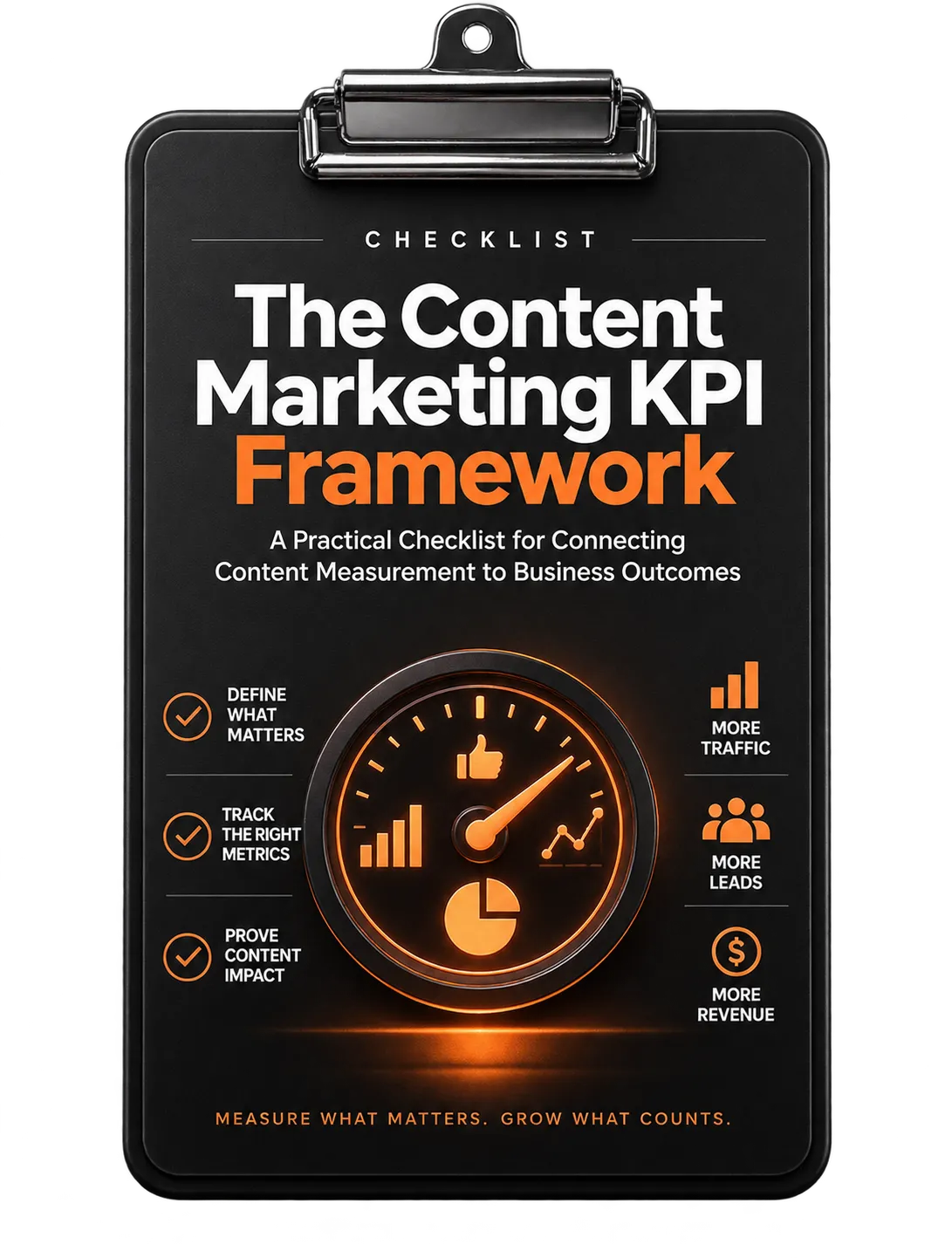
Effective content measurement requires more than collecting numbers. The Content Marketing KPI Framework provides a structured checklist for connecting content activity to business outcomes and moving beyond vanity metrics.
The framework begins with measurement foundations, then moves through data collection, attribution, dashboards and automation, and executive communication. Together, these areas create a practical path from collecting content data to using that data for better decisions.
1. Establish the Measurement Foundation
A reliable measurement system starts by deciding what should actually be measured. Begin by reviewing existing metrics and identifying vanity metrics that do not connect directly to business outcomes. The resource specifically highlights metrics such as page views and social shares as examples that may not provide meaningful business context on their own.
Create a Three-Tier KPI Hierarchy
Organize content KPIs into three levels:
- Engagement KPIs: Measure how audiences interact with content.
- Conversion KPIs: Measure movement through the funnel.
- Revenue KPIs: Measure direct financial outcomes.
This hierarchy provides a broader view of content performance across the customer journey instead of focusing on a single category of metrics.
Standardize KPI Definitions
Document precise formulas and calculation methods for each KPI. Definitions should be specific enough to prevent metric drift. For example, the framework recommends documenting exactly how Content-Qualified Leads are calculated, including the attribution window used.
Assign owners to each KPI so that specific individuals or departments are responsible for accuracy, interpretation, and optimization. Regular quarterly reviews can then be used to check whether definitions remain aligned with changing business objectives.
2. Set Up Consistent Data Collection
Measurement depends on consistent data. Establish standardized UTM parameter naming conventions across campaigns and content so attribution data does not become fragmented.
A content tagging taxonomy should also categorize content by relevant dimensions such as:
- Content type
- Topic
- Funnel stage
- Audience segment
Consistent tagging makes it possible to segment content performance and identify meaningful patterns.
Create a Measurement Plan
Document which metrics will be tracked, why they matter, how the data will be collected, and who is responsible for acting on the resulting insights. This turns measurement into a deliberate process rather than a collection of disconnected tracking activities.
Combine Quantitative and Qualitative Data
Quantitative metrics do not always explain why something happened. The framework recommends adding contextual feedback mechanisms such as on-page surveys, exit polls, heatmaps, and user session recordings.
Monthly data quality audits should also check UTM consistency, integration accuracy, and data completeness across platforms so problems can be identified before they compound.
3. Implement an Attribution Model
Attribution helps connect content touchpoints with the customer journey. The framework recommends choosing an attribution model based on conversion volume, sales cycle length, and available data.
For many teams, the resource identifies position-based (U-shaped) and time-decay models as approaches that can balance insight with implementation complexity.
Map Content to Buyer Stages
Document how content interactions typically occur across the awareness, consideration, and decision phases. This helps clarify the role individual content assets play within the customer journey.
Use Appropriate Attribution Windows
Lookback periods should reflect the actual sales cycle. The framework gives longer windows of 60–180 days for B2B and shorter windows of 7–30 days for B2C or e-commerce as examples.
Attribution logic should then be validated against sample customer journeys to determine whether credit assignment reflects realistic influence patterns. Schedule quarterly attribution reviews to reassess the model, windows, and weights as business conditions change.
4. Build Dashboards That Drive Action
A dashboard should help stakeholders make decisions, not simply display data. Start by interviewing stakeholders about the decisions they make and the metrics that guide those decisions.
Design Dashboards Around Stakeholder Roles
The framework recommends tailoring dashboards to different responsibilities:
- Executives: Strategic overview.
- Managers: Operational metrics.
- Content creators: Tactical insights.
Role-specific views help each stakeholder focus on the information relevant to their responsibilities without unnecessary complexity.
Automate Reporting
Automated reporting can shift the team away from compiling data and toward analyzing it. The framework recommends setting up nightly data refreshes, weekly email digests, and monthly executive summaries.
Anomaly detection can complement automated reporting by establishing thresholds that trigger notifications when important metrics move significantly outside normal ranges. This can help surface problems and opportunities while they remain actionable.
Document How to Interpret the Dashboard
Simple interpretation guides should explain how stakeholders should read dashboard insights and what actions they can take from them. Clear guidance helps turn an analytics system into a decision-support system.
5. Communicate Content Performance to Executives
Content reporting becomes more useful when metrics are connected to the priorities of executive stakeholders. The framework recommends connecting content KPIs to areas such as revenue growth, cost efficiency, competitive position, and sales acceleration.
Create an Executive Summary
Develop a one-page executive summary that communicates content's business impact using financial language rather than marketing jargon. The resource recommends keeping this summary to a maximum of 200 words.
Use a Consistent Board Presentation Structure
The framework recommends a focused four-slide structure:
- Goals
- KPI snapshot
- Key drivers
- Action or ask
This structure keeps the presentation focused on the information leadership needs while respecting executive time constraints.
Turn Data Into a Story
Raw metrics become more useful when they are framed as a narrative. The resource recommends using the “What? So What? Now What?” structure to move from an observed result to its significance and then to a strategic recommendation.
This approach helps make complex analytics easier for executive audiences to understand and connects measurement with action.
Putting the Framework Into Practice
The checklist can be approached as a sequence of implementation areas:
- Build the foundation: Audit existing metrics, define the KPI hierarchy, document formulas, assign owners, and review definitions regularly.
- Set up data collection: Standardize UTM parameters, establish content tagging, document the measurement plan, collect qualitative data, and audit data quality.
- Implement attribution: Select an appropriate model, map content to buyer stages, configure attribution windows, validate the logic, and review the model quarterly.
- Create dashboards and automation: Understand stakeholder needs, build role-specific dashboards, automate reporting, configure anomaly alerts, and document interpretation guidance.
- Improve executive communication: Connect metrics to executive priorities, create concise summaries, structure board presentations, and use data storytelling to turn measurement into recommendations.
The result is a more structured approach to content measurement, where KPI definitions, data collection, attribution, reporting, and executive communication work together rather than operating as separate activities.
From Metrics to Business Decisions
The central purpose of the framework is to make content measurement useful for business decision-making. Instead of collecting metrics simply because they are available, the checklist encourages teams to establish why each metric matters, how it should be calculated, who owns it, how it connects to the customer journey, and how its insights will be communicated.
Use the complete checklist as the implementation companion for putting these practices into place across your content marketing measurement process.