Turn Existing Content Into a Repeatable Content System
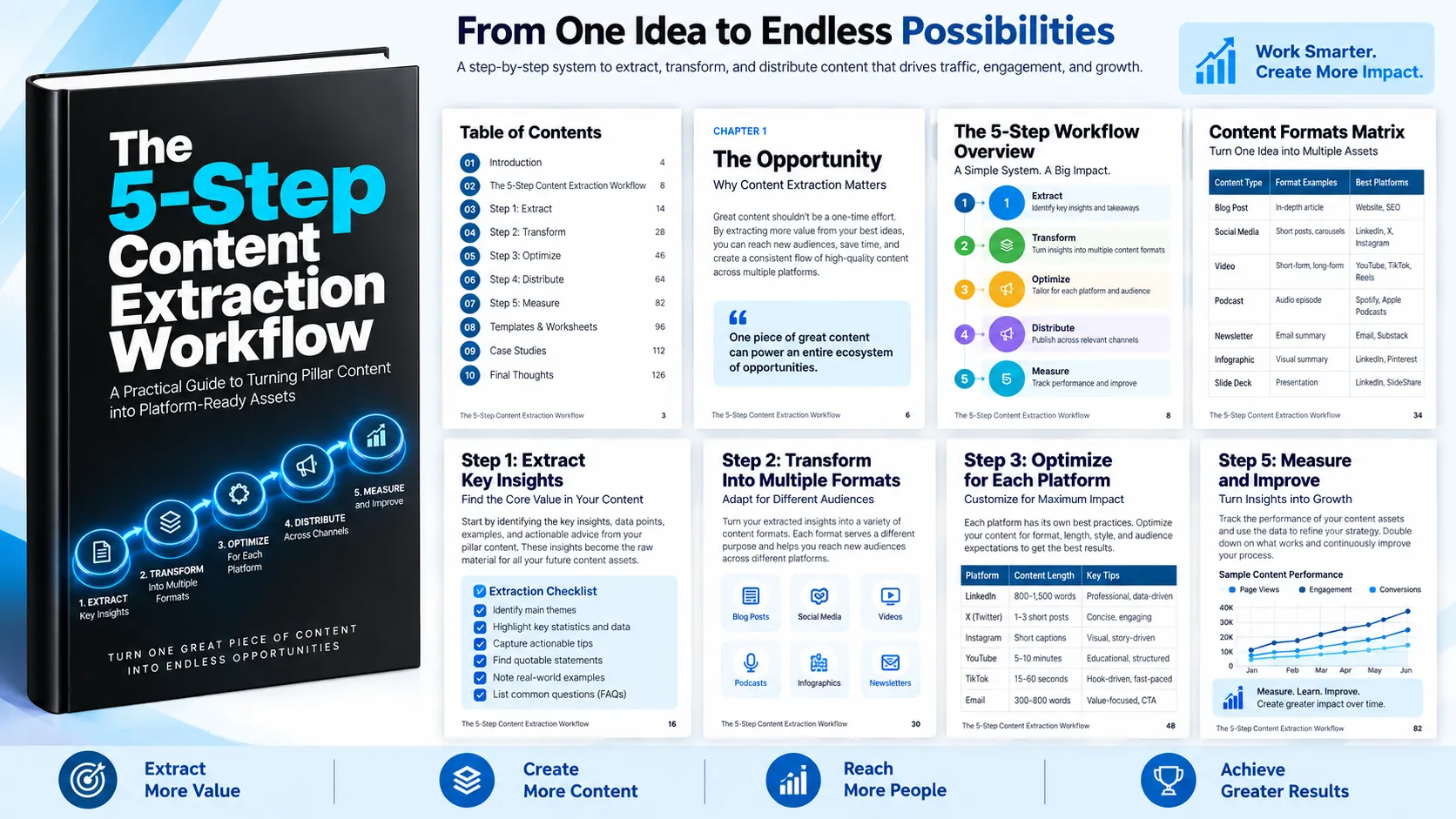
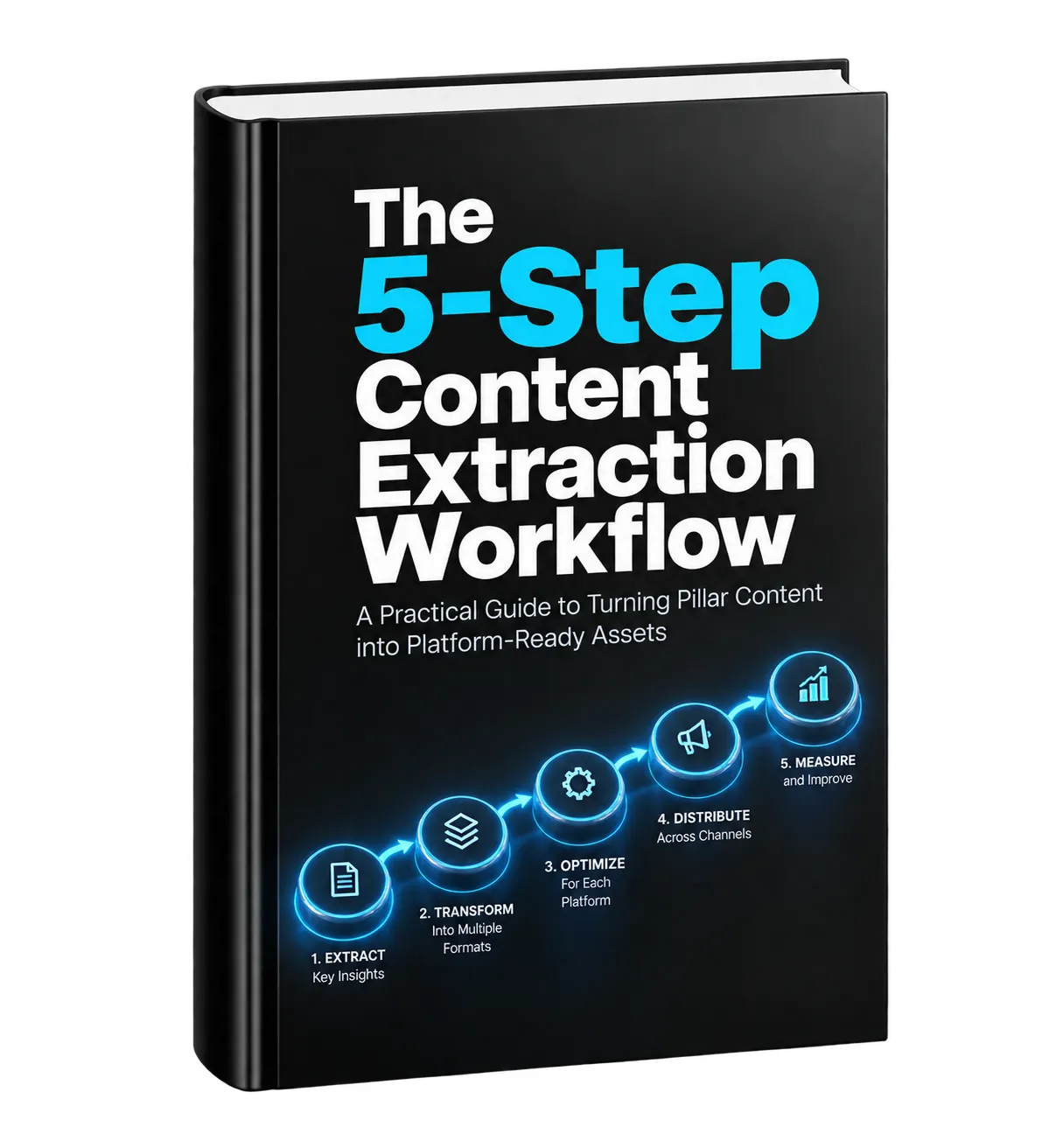
Consistently creating fresh content for multiple platforms can become an ongoing production challenge. The 5-Step Content Extraction Workflow takes a different approach: start with valuable pillar content you already have and systematically identify the components that can be reused in other formats.
Content extraction is the process of breaking down pillar content such as webinars, podcasts, and long-form articles into modular components that can be repurposed across different platforms. The goal is to create a bridge between the original pillar asset and the places where your audience consumes content.
The workflow is built around content atomization. Instead of treating a webinar, article, or podcast as one indivisible piece, you identify smaller ideas, insights, stories, statistics, frameworks, and instructions that can become independent content assets.
Step 1: Identify an Extraction-Ready Pillar Asset
The first step is choosing content that contains enough valuable material to support multiple derivatives. Not every piece of content is equally suitable for extraction.
Strong pillar content generally has several characteristics:
- Comprehensive coverage: It contains multiple subtopics or useful points.
- Structured format: It has clear sections, timestamps, or another logical structure.
- Evergreen relevance: It addresses problems that remain useful over time.
- Audience validation: It addresses known or demonstrated audience pain points.
- Rich content elements: It includes data, stories, frameworks, or actionable steps.
Suitable formats include webinars, podcast episodes, long-form blog posts, comprehensive guides, whitepapers, recorded presentations, keynotes, and in-depth video tutorials.
Prepare Before You Extract
Gather the original pillar content, a transcription when working with audio or video, supporting materials such as slides or research, a brand style guide, and a channel strategy document.
If you are creating new pillar content specifically for future extraction, the guide recommends building natural breaks and modular sections into the planning process and identifying potential extraction points before recording or writing.
Step 2: Hunt for High-Value Content Atoms
Once the pillar asset is selected, the next task is to find the modular components that can become new pieces of content. The guide identifies five particularly useful content atoms.
Quotables
Quotables are memorable phrases that capture an important insight. Look for bold statements, contrarian views, and concise summaries. These can become social quote cards, thread starters, or email subject lines.
Statistics
Statistics are data points, percentages, comparisons, or research findings that can challenge assumptions or make an idea more concrete. They can be transformed into data visualizations, carousel openers, and hook statements.
Frameworks
Frameworks simplify complex concepts through processes, methodologies, decision matrices, or other structured models. They are well suited to infographics, carousel slides, and checklist-style resources.
Stories
Stories provide narrative examples of transformation, including client examples, personal anecdotes, and problem-solution scenarios. They can become short-form videos, case-study content, or email openers.
Step-by-Step Instructions
Procedural content explains how to accomplish something through clear stages. Tutorials, implementation guides, and actionable advice can be adapted into carousel how-tos, threads, and video tutorials.
Extract According to the Original Content Format
The extraction process should reflect the format of the pillar asset.
Video and Webinar Content
Use timestamp notes to mark strong moments, identify natural breaks between topics, pay attention to audience questions, note moments of high energy or emotional response, and extract useful slides as standalone visuals.
Audio and Podcast Content
Mark compelling segments during editing, identify strong opening hooks and closing summaries, capture guest quotes or surprising statements, note topic transitions, and flag stories or examples that work independently.
Written Content
Highlight sentences that summarize key points, extract useful bullet lists, identify data worth visualizing, locate frameworks or processes that can become visuals, and pull out compelling examples or case studies.
Use a Consistent Extraction Tagging System
Finding content atoms is only useful if you can organize them. The guide recommends tagging every extracted component using five pieces of information:
- Atom Type: Quote, Stat, Framework, Story, or Steps.
- Source Location: Timestamp, slide number, or paragraph reference.
- Core Message: The essential takeaway in one or two sentences.
- Potential Platforms: Where the component could work best.
- Visual Needs: Graphic elements that could strengthen the component.
This structure creates a clear connection between the original source, the extracted idea, and its intended transformation.
Step 3: Build Your Extraction Sheet
The extraction sheet acts as the central repository for repurposing opportunities. It can be built in a spreadsheet, database, or project management tool.
The recommended essential fields include:
- ID
- Atom Type
- Source
- Raw Content
- Core Message
- Target Platforms
- Format
- Status
- Due Date
- Owner
- Notes
For larger content libraries, the guide also recommends adding topic tags, funnel stages, priority scores, difficulty ratings, and grouping IDs. These fields make it easier to filter related content, prioritize opportunities, estimate production complexity, and connect atoms that could become a series.
Run a Content Atom Scavenger Hunt
A practical exercise in the guide is to select a recent pillar asset and spend 15 minutes scanning it for potential atoms. The suggested target is at least five quotables, three statistics or data points, two frameworks or processes, two stories or examples, and three step-by-step instructions.
Logging these findings in the extraction sheet provides a quick view of how much repurposing potential exists within an existing pillar asset.
Step 4: Transform Components Into Platform-Ready Assets
Raw content atoms should not simply be copied from one platform to another. Each component needs to be transformed into an asset that fits the destination platform.
Quotables to Social Graphics
- Select a template that matches the platform dimensions.
- Highlight the key phrase, keeping it concise.
- Add attribution where appropriate.
- Apply brand elements such as logo, colors, and fonts.
- Create variations for different platform formats.
Statistics to Data Visualizations
- Choose an appropriate chart type.
- Simplify the data around the important comparison.
- Add context explaining why the data matters.
- Include source attribution.
- Apply consistent brand elements.
Frameworks to Infographics or Carousels
Map the logical flow of the framework, establish a clear visual hierarchy, use concise labels, include brief implementation instructions, and number the steps when sequence matters.
Stories to Video Clips or Case Studies
Identify the narrative arc, create a concise version, add supporting visuals, include important results or quotes, and finish with a clear takeaway.
Step-by-Step Content to Tutorials or Carousels
Break the process into stages, create a visual for each step, keep instructions brief, add visual cues such as arrows or highlights, and show the final outcome.
Adapt Content for the Destination Platform
Platform adaptation goes beyond changing dimensions. The guide recommends checking technical specifications, content adaptation, branding, and the call to action.
- Technical specifications: Confirm dimensions, file format, file size, and resolution.
- Content adaptation: Adjust tone, platform-specific elements, engagement prompts, and length.
- Branding: Maintain logo placement, brand colors, typography, and visual identity.
- Call to action: Use a platform-appropriate CTA, correct link format, tracking parameters, and a logical next step.
The important principle is that extracted content should feel native to its destination rather than looking like the same asset copied across every channel.
Step 5: Apply Quality Control and Schedule the Content
Before extracted content is published, the guide recommends a three-point quality control system.
1. Message Integrity Check
Confirm that the core promise remains consistent, no factual errors were introduced, the necessary context remains intact, supporting evidence is included where needed, and source attribution is maintained.
2. Brand Consistency Check
Review visual identity, tone of voice, terminology, overall quality, and any necessary disclaimers. The final asset should still feel like it belongs to the original brand.
3. Platform Optimization Check
Confirm that the format follows platform requirements, engagement mechanics are appropriate, technical specifications are correct, the CTA fits the platform context, and the cross-platform content journey makes sense.
Schedule Extracted Content as a System
Once content has passed quality control, scheduling should be handled in batches rather than as a daily scramble.
The guide suggests several scheduling rhythms:
- Weekly: A 90-minute focused session for one pillar asset.
- Bi-weekly: A three-hour deep dive across multiple assets.
- Monthly: A half-day batching session for major pillar content.
For individual content pieces, related assets can be staggered across seven to ten days. High-impact formats can lead the sequence, platform-specific posting times should be considered, related extracts can become mini-series, and different content types should be balanced throughout the week.
Create Ready-to-Ship Content Bundles
Each scheduled piece should have everything required for publication in one bundle: the primary asset files, draft caption, hashtags and mentions where appropriate, supporting assets such as alt text and destination links, tracking parameters, and notes about the engagement strategy.
The guide also recommends consistent file naming such as Topic-Platform-PublishDate.filetype to keep the growing content library organized.
A Repeatable Weekly Extraction Calendar
The workflow can be integrated into a weekly content process:
- Monday: Extract content atoms from the latest pillar asset.
- Tuesday: Transform high-priority atoms into platform-ready assets.
- Wednesday: Conduct quality review and revisions.
- Thursday: Schedule content across platforms with staggered timing.
- Friday: Review performance from previously published extracts and use the insights to improve the next cycle.
The guide's calendar allocates 90 minutes for extraction, two hours for transformation, 45 minutes for review, 30 minutes for scheduling, and 30 minutes for performance review.
Common Content Extraction Challenges
Content Overwhelm
When there are too many possible extracts, the guide recommends the ICE prioritization method: Impact, Confidence, and Ease. Score each from 1 to 10, multiply the scores, and prioritize the highest-scoring opportunities.
Format Fatigue
If the same derivative formats are being created repeatedly, rotate formats across weeks. The guide suggests moving between visual formats, video formats, text-based formats, and new or hybrid formats.
Quality Inconsistency
Create template systems for each platform, develop several design templates for each content type, establish adaptation guidelines, and use quality-control checklists.
Losing the Core Message
Write a one-sentence core promise for each pillar asset and review every derivative against it. The guide also recommends an “explain it to a 10-year-old” test and, where possible, review by someone unfamiliar with the original content.
Poor Performance Tracking
Use UTM parameters consistently, add performance information to the extraction sheet, track a small number of relevant metrics for each format, and review results monthly to identify patterns.
Build the System Over Time
The workflow becomes more valuable as the extraction process becomes repeatable. Start with one existing pillar asset, create the extraction sheet, schedule an extraction session, and identify a manageable set of content atoms.
Next, transform the highest-priority atoms, apply quality control, schedule the derivatives, and track their initial performance. Over the following weeks, refine the extraction sheet, experiment with new transformation techniques, and identify which content atoms perform best.
Over a longer period, develop a content atom library organized by topic and format, create templates for successful derivative formats, and introduce automation where it can streamline the extraction process.
The Core Idea
Content extraction changes the role of pillar content. Instead of treating a webinar, podcast, article, or guide as a single finished asset, the workflow turns it into a source for a growing library of modular content.
With a structured process for identifying, tagging, organizing, transforming, reviewing, and scheduling those components, content production can become more systematic and less dependent on creating something completely new every day.
The guide's central principle is simple: work smarter with the valuable ideas you already have. Over time, stronger extraction skills and a growing component library can make each cycle more efficient while maintaining quality, consistency, and strategic focus.
Download the complete guide to work through the full workflow, exercises, extraction-sheet structure, transformation techniques, quality-control system, scheduling calendar, challenge solutions, and action plan.