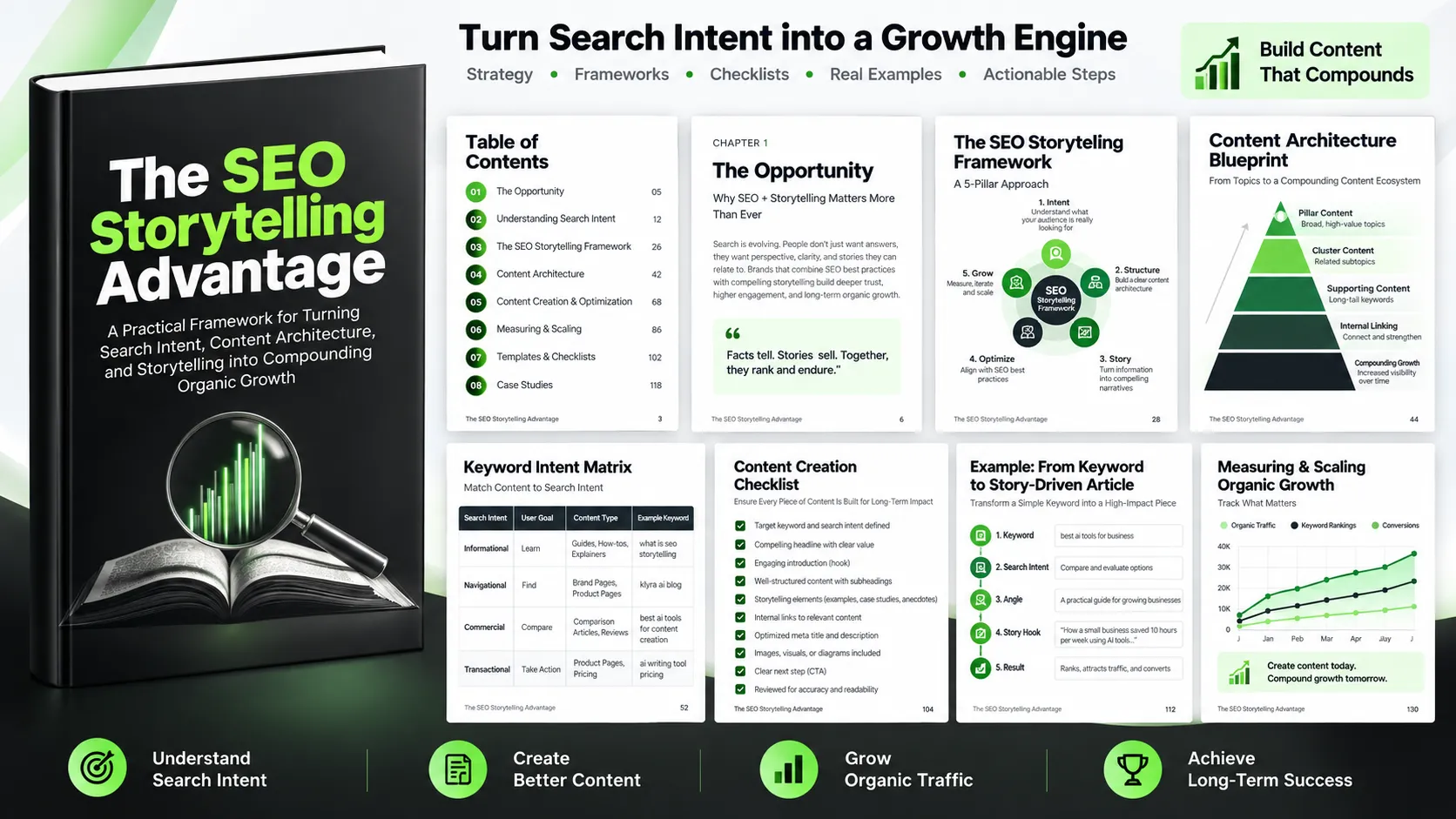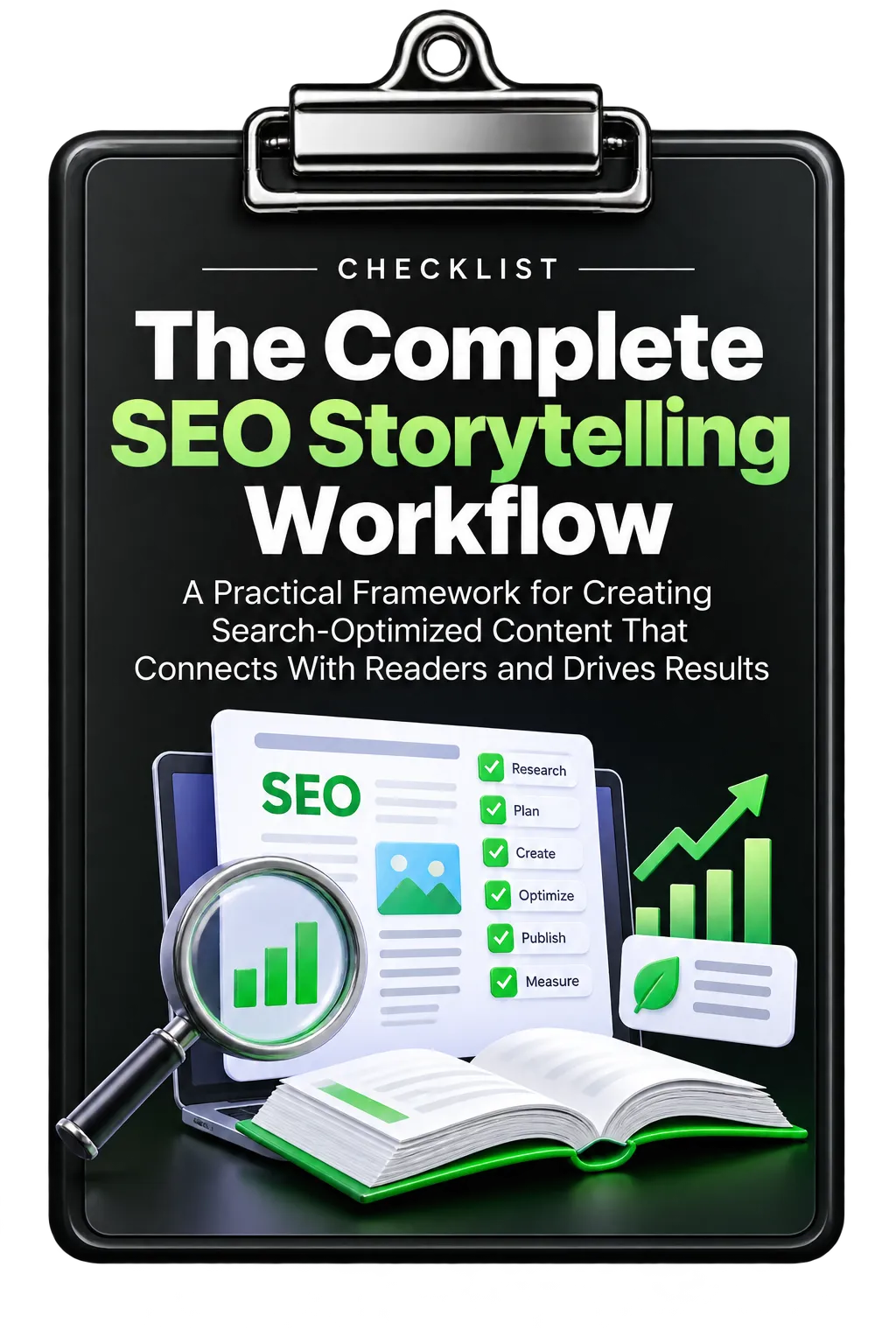
The SEO Storytelling Advantage
Search visibility alone does not guarantee that content will create meaningful results. A page can rank well and still fail to connect with readers, while compelling content can struggle to reach the people searching for it. SEO storytelling brings these two disciplines together by creating content that responds to search intent while also addressing the motivations, concerns, and expectations of real people.
The central idea of this resource is that effective SEO should not feel like SEO. Instead of producing keyword-stuffed pages or creating content without a clear discovery strategy, the approach combines search behavior with narrative thinking. When readers find what they are looking for in content that is relevant, coherent, and genuinely useful, the content has a stronger opportunity to earn engagement, exploration, sharing, and long-term visibility.
The resource develops this approach through a connected system covering audience research, keyword storylines, narrative architecture, on-page SEO, distribution, measurement, scaling, and evergreen optimization.
1. Start With People, Then Understand Search
Effective SEO storytelling begins with understanding the audience behind the search. Demographics can describe who an audience is, but psychographics help explain why people make decisions, what they worry about, what they hope to achieve, and how they describe their problems.
An empathy map provides a practical way to organize these insights across four areas:
- Thinks: Internal beliefs and important considerations.
- Feels: Emotions, hopes, and concerns surrounding the topic.
- Says: How people describe their needs to others.
- Does: The actions they take to solve their problem.
These insights can be gathered from both quantitative and qualitative sources. Analytics can reveal content consumption patterns, CRM data can provide customer journey information, and heatmaps can show engagement. Support tickets, sales conversations, Reddit, Quora, and industry forums can reveal the language people actually use when discussing their problems.
The objective is to turn this research into a practical audience avatar that connects goals, obstacles, information triggers, and desired outcomes with potential content angles.
Decode Search Intent Through the SERP
Once the audience is understood, the next step is understanding how that audience searches. The resource identifies four broad search-intent categories: informational, navigational, commercial, and transactional.
Search results can provide additional clues about intent. Query modifiers such as “how,” “why,” “best,” and “buy” can signal different needs. Ad density, domain types, content formats, schema, and freshness dates can also help reveal what searchers are looking for.
The important point is that search intent is not always isolated to one category. A single search journey can combine informational, commercial, and transactional signals. Content strategy should therefore consider both the stated query and the underlying motivation behind it.
2. Turn Keyword Lists Into Keyword Storylines
A large keyword list can quickly become difficult to manage. When similar keywords are assigned to multiple pages without a clear structure, content can overlap, pages can compete with one another, and search engines may have difficulty determining which page best answers a query.
The resource introduces the Keyword Storyline Framework, a process for transforming keyword data into focused content clusters and connected narratives.
The Four-Step Keyword Clustering Workflow
- Harvest: Gather keywords from search data, competitor analysis, and audience research.
- Clean: Remove irrelevant terms, duplicates, and inconsistent formats.
- Categorize: Group terms according to semantic relationships, search intent, and audience needs.
- Validate: Review search results to confirm that keywords within a cluster have sufficiently similar intent.
The resource recommends combining algorithmic clustering with human judgment. Automated tools can identify semantic relationships and search-volume patterns, while human review adds context around audience needs, brand positioning, and the customer journey.
From Clusters to Narrative Angles
Keyword clustering is only the structural foundation. Each cluster also needs a narrative angle that gives the content a reason to exist beyond targeting keywords.
Three narrative approaches highlighted in the resource are the hero's journey, where the reader overcomes a challenge with guidance; myth-busting, where misconceptions are challenged using evidence and expert insight; and transformation case studies, where a before-and-after journey demonstrates an approach.
The same keyword cluster can support different narratives depending on audience motivations and brand positioning. This allows content teams to compete through relevance and perspective rather than simply attempting to reproduce what already exists in search results.
Build a Pillar-and-Cluster Architecture
A topic cluster creates a connected content ecosystem. The pillar page acts as the comprehensive hub for a broad subject, while supporting cluster content explores specific aspects in greater depth.
Clusters can also be mapped to awareness, consideration, and decision stages. This helps prevent a content strategy from becoming overly focused on informational topics while neglecting content that supports evaluation and decisions.
Internal linking connects the ecosystem. Cluster articles should link to their pillar page and to other relevant supporting content using descriptive anchor text that helps readers and search engines understand the relationship between pages.
Content architecture also needs maintenance. Overlapping pages may need to be consolidated, redirected, or repositioned, while regular link audits can identify broken or isolated content. The resource recommends leaving room for new clusters as search behavior and emerging questions evolve.
3. Build Pages Around Narrative Architecture
Once audience motivations and keyword clusters are established, individual pages need a structure that guides readers from discovery to action.
The resource describes a narrative-optimized page using several connected elements:
- Headline: Earn attention while communicating the primary topic.
- Lede: Establish context and create an immediate reason to continue.
- Promise: Clarify the value the reader can expect.
- Body: Deliver information through digestible sections.
- Proof: Establish credibility through evidence, expertise, and trustworthy information.
- Transition: Guide the reader naturally toward the next idea.
- CTA: Give the reader a clear next action.
- SEO aftercare: Address related questions and expand useful query coverage.
Use Micro-Scenes to Maintain Momentum
Long blocks of text can make complex content difficult to consume. The resource recommends breaking the body into smaller “micro-scenes,” with each section addressing a specific problem or question, providing an explanation, and reaching a useful takeaway.
These sections can also respond to the emotional needs identified during audience research. For example, if an audience is anxious about making the wrong decision, individual sections can address specific decision criteria and provide clarity around each concern.
Create Semantic Depth Without Keyword Stuffing
Modern SEO requires more than repeating the same keyword. Search engines can evaluate relationships between terms and concepts, making semantic depth an important part of content structure.
The primary keyword can appear in the headline and opening content, while secondary terms and related concepts can be incorporated naturally into subheadings, body content, image descriptions, internal links, and supporting sections.
The resource emphasizes that natural integration should take priority over rigid keyword placement. Forced repetition can damage the reading experience and undermine the purpose of creating human-centered content.
Apply the “Skim, Scan, Settle” Test
Before publishing, evaluate the page at three reading levels. First, skim the headline and subheadings to see whether the structure communicates a coherent story. Next, review the opening sentence of each paragraph to understand how the page works for scanners. Finally, read individual sections in depth to ensure they provide a smooth and complete experience.
This approach accommodates readers at different stages of the customer journey, from people quickly exploring a topic to visitors looking for detailed information about a specific concern.
4. Make On-Page SEO Support the Story
Technical SEO elements should strengthen the narrative rather than replace it. Metadata, headings, schema, internal links, multimedia, and readability all contribute to how effectively a page communicates with both search engines and people.
Metadata That Earns Attention
The resource recommends treating metadata as a concise preview of the content's value. A title can combine the primary keyword with an emotional hook and brand, while the meta description can communicate the expected payoff and encourage the searcher to click.
Each page should have one clear H1 aligned with primary intent, followed by a logical H2 and H3 hierarchy. Open Graph and social card information should also be considered because content is often discovered and shared outside traditional search results.
Schema and Search Visibility
Schema markup provides structured information that helps search engines understand content context. The resource highlights Article, FAQ, HowTo, and VideoObject as useful schema types for different content purposes and recommends validating structured data with Google's Rich Results Test.
Internal Links and Multimedia
Internal links help distribute authority, establish relationships between pages, and guide readers through a content ecosystem. Descriptive anchor text should communicate what the destination page contains while varying naturally across the site.
Multimedia can also strengthen the experience. Images should be compressed appropriately, given descriptive filenames and accurate alt text. Videos can benefit from relevant structured data, useful thumbnails, and transcripts that improve accessibility while providing additional indexable text.
5. Distribute Content and Earn Authority
Creating strong content is only one part of the process. Distribution helps turn narrative assets into visibility and authority assets.
The resource divides distribution into three broad channel types: owned channels such as websites and email lists, earned channels such as media mentions and community participation, and paid channels such as sponsored content and social advertising.
The appropriate mix depends on the customer journey. Broad social networks can support awareness, forums and email can support research and consideration, and targeted email or paid campaigns can support decision-stage activity.
Use Community Seeding Strategically
Effective community distribution is not simply publishing the same message everywhere. The resource recommends identifying communities where the audience is active, observing what generates engagement, adapting content to the specific problems discussed there, and measuring which angles generate meaningful interactions.
Earn Links Through Value
The resource presents a “give, guide, gain” approach to ethical link acquisition.
- Give: Offer something genuinely useful, such as original research, expert commentary, or a resource that fills a content gap.
- Guide: Make it easy for the recipient to use the resource by explaining where and how it fits into their existing content.
- Gain: Allow the link or citation to become the natural result of the value provided.
Potential link opportunities should be evaluated for topical relevance as well as authority and traffic potential. A relevant citation from a site operating in the same subject area can strengthen topical relationships more effectively than an unrelated mention.
Repurpose the Core Asset
The resource recommends content atomization, where one substantial asset is transformed into multiple platform-specific formats. The “rule of 8” suggests generating at least eight derivative pieces from a core asset.
Possible formats include social posts, slide decks, short articles, downloadable checklists, video tutorials, guest articles, and webinar outlines. Each derivative should be adapted to the platform rather than copied unchanged.
UTM tracking can reveal which formats and channels generate the most valuable traffic, creating a feedback loop for future distribution decisions.
6. Measure Content From Search Visibility to Revenue
Measurement turns content strategy from guesswork into a feedback system. A useful performance dashboard should connect search visibility, engagement, conversions, and business outcomes across the customer journey.
The resource identifies four essential data categories:
- Search data: Impressions, click-through rates, and keyword positions.
- Engagement data: Time on page, scroll depth, and bounce rate.
- Conversion data: Newsletter signups, demo requests, and purchases.
- Revenue and LTV data: Initial and lifetime value attributed to content.
A dashboard should also have a North Star metric that represents the most important business impact of the content program. The appropriate metric depends on the business model and its objectives.
Connect Leading and Lagging Indicators
Leading indicators can provide early signals of future performance, such as impression growth or improving search positions. Lagging indicators confirm business outcomes, such as qualified leads, pipeline contribution, or recurring revenue.
The resource highlights eight useful numbers for connecting visibility through revenue: organic impressions, click-through rate, time on page, scroll depth, newsletter signups, sales-qualified leads, assisted revenue, and lifetime-value uplift.
Use Cohorts and Attribution
Cohort analysis compares groups of users based on how and when they interact with content. Segmenting visitors by entry point can reveal differences in engagement and conversion behavior that basic pageview reporting may hide.
Attribution models also influence how content value is understood. First-touch attribution emphasizes content that initiates relationships, last-touch attribution emphasizes the final conversion interaction, and data-driven or multi-touch approaches distribute credit across the customer journey.
Test, Learn, and Iterate
The resource introduces the HTMI loop: make a hypothesis, test it, measure the result, and iterate based on what is learned.
Tests can address title tags, page experience, content structure, or distribution. The ICE framework can help prioritize experiments according to estimated impact, confidence, and ease of implementation.
Content should also be reviewed on a recurring schedule. Traffic plateaus and declining performance can trigger targeted updates, while larger content overhauls can be reserved for pages that need more substantial improvement.
7. Scale the Story Factory Without Losing Quality
As content volume increases, scaling requires more than producing more articles. The resource identifies three interconnected levers: people, process, and technology.
Build Clear Roles and Responsibilities
A scalable content operation can include roles such as content strategist, SEO analyst, managing editor, subject-matter writer, multimedia producer, outreach and partnerships lead, and content operations manager.
These roles do not necessarily require seven separate full-time employees. Hiring models can include in-house teams, freelancers, agencies, or hybrid structures depending on the organization's needs, budget, speed requirements, and access to expertise.
A RACI matrix can clarify who is responsible, accountable, consulted, and informed for each content type, reducing ambiguity as the team grows.
Create Repeatable Processes
A strong editorial calendar connects publication timing with seasonal trends, business priorities, funnel stages, keyword clusters, content formats, ownership, status, and performance targets.
Workflow automation can reduce manual handoffs. Project management tools and automation platforms can notify contributors when content moves between stages, while shared style guides can maintain consistency around voice, SEO requirements, inclusive language, citations, and sourcing.
The resource recommends a three-stage quality process: narrative editing, SEO review, and final proofing for grammar and facts. Regulated industries may add a compliance review.
Use AI Without Diluting Human Voice
AI can support content operations in areas such as SERP analysis, first-draft outlines, content repurposing, and metadata experimentation. The resource positions these uses as ways to enhance human creativity rather than replace it.
Its recommended guardrails include beginning with a human-written brief, limiting AI contribution to no more than 40% of final copy, checking outputs for plagiarism and factual accuracy, verifying brand alignment, logging AI usage, and requiring final human approval.
The underlying principle is human-in-the-loop content production: AI can assist with drafting and analysis, while people remain responsible for judgment, quality, voice, and publication decisions.
8. Build Evergreen Momentum
Content performance does not end at publication. Evergreen content requires continued measurement, maintenance, and adaptation as search behavior, audience needs, and search results evolve.
The Five-Stage Evergreen Flywheel
- Create: Build foundational content using the narrative architecture.
- Measure: Track performance through the established dashboards.
- Refresh: Update content based on performance and changes in search results.
- Repurpose: Turn updated content into additional formats.
- Amplify: Redistribute refreshed content to reach new audiences.
This cycle replaces the “publish and forget” approach with an ongoing system for maintaining useful content. Each refresh can build on the authority and learning accumulated from previous work.
Detect Content Decay
Content decay can appear through declining rankings, falling click-through rates despite stable impressions, or reduced engagement. Before rewriting a declining page, the resource recommends asking three questions:
- Has search intent changed?
- Are competitors providing fresher information?
- Has the page structure fallen behind current SERP features?
The cause may be relatively focused, such as outdated statistics, missing multimedia, or neglected schema, rather than a fundamental problem with the content itself.
Use Quick Wins Before Full Rewrites
Not every declining page needs a complete rewrite. The resource highlights several small improvements that can be completed quickly, including refreshing title tags, updating statistics, adding FAQ schema, incorporating user quotes, improving paragraph structure, strengthening internal links, enhancing meta descriptions, improving image alt text, adding summaries, and sharpening CTAs.
These improvements should be prioritized around actual search and engagement signals. High-traffic pages showing declining engagement can provide particularly useful opportunities for targeted refreshes.
Future-Proof Through Experimentation
Future-proofing requires a test-and-learn culture. Algorithm changes and emerging SERP features can be treated not only as risks but also as opportunities to experiment early with new formats and visibility opportunities.
The resource also recommends revisiting audience empathy maps annually because changes in search behavior can reflect changes in audience needs and expectations.
Turn Content Into a Continuous System
The complete framework connects several activities that are often treated separately: understand the audience, decode search intent, cluster keywords, create narrative angles, build connected content architecture, optimize individual pages, distribute and repurpose assets, measure business impact, scale production responsibly, and continually refresh what has already been created.
The value of this approach comes from the connections between these stages. Audience research influences search-intent interpretation. Search intent informs keyword clusters. Keyword clusters shape narrative architecture. Narrative content benefits from technical SEO. Distribution creates additional visibility and authority. Measurement reveals what is working. Testing improves execution. Scaling systems make the process repeatable. Evergreen maintenance keeps the resulting content useful.
The resource therefore treats SEO storytelling as an ongoing operating system for content rather than a one-time optimization exercise.
A Practical Starting Point
The resource closes with a focus on action. Start by identifying the areas where the framework can create the most immediate improvement.
- Review your audience motivations and create or update an empathy map.
- Take an existing keyword spreadsheet and organize it into focused clusters.
- Identify one pillar topic and supporting cluster topics.
- Audit an existing page using the narrative and on-page SEO principles.
- Choose one content asset to repurpose into multiple formats.
- Build a dashboard that connects search visibility with engagement and business outcomes.
- Identify one content experiment using the HTMI and ICE frameworks.
- Find one declining content asset and determine whether it needs a targeted refresh.
The long-term objective is not simply to publish more content. It is to create a content ecosystem where useful stories are discoverable, connected, distributed, measured, improved, and maintained over time.
Stories that genuinely serve human needs while satisfying search intent can become lasting content assets.