Finding Profit Opportunities in Everyday Business Operations
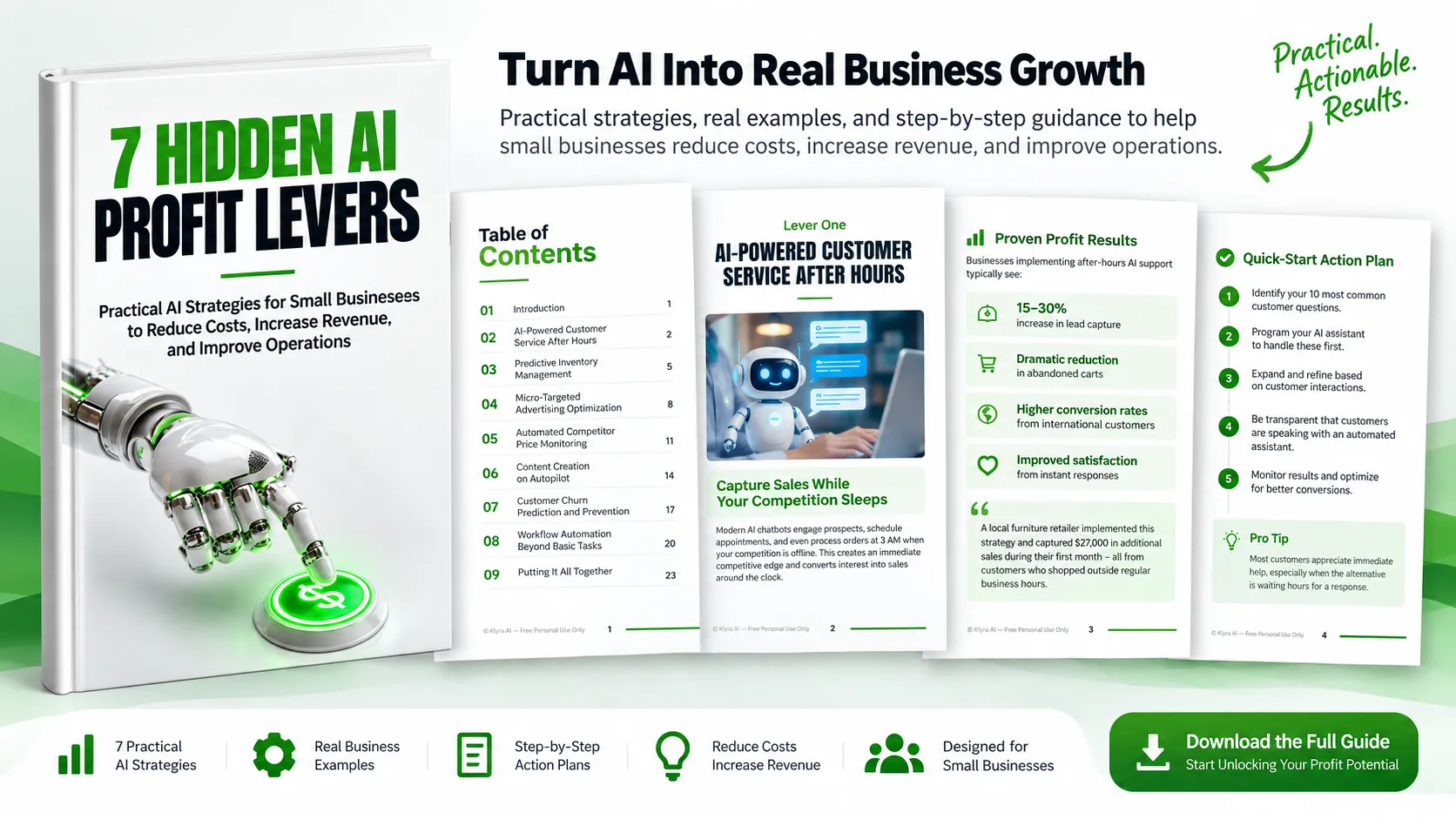
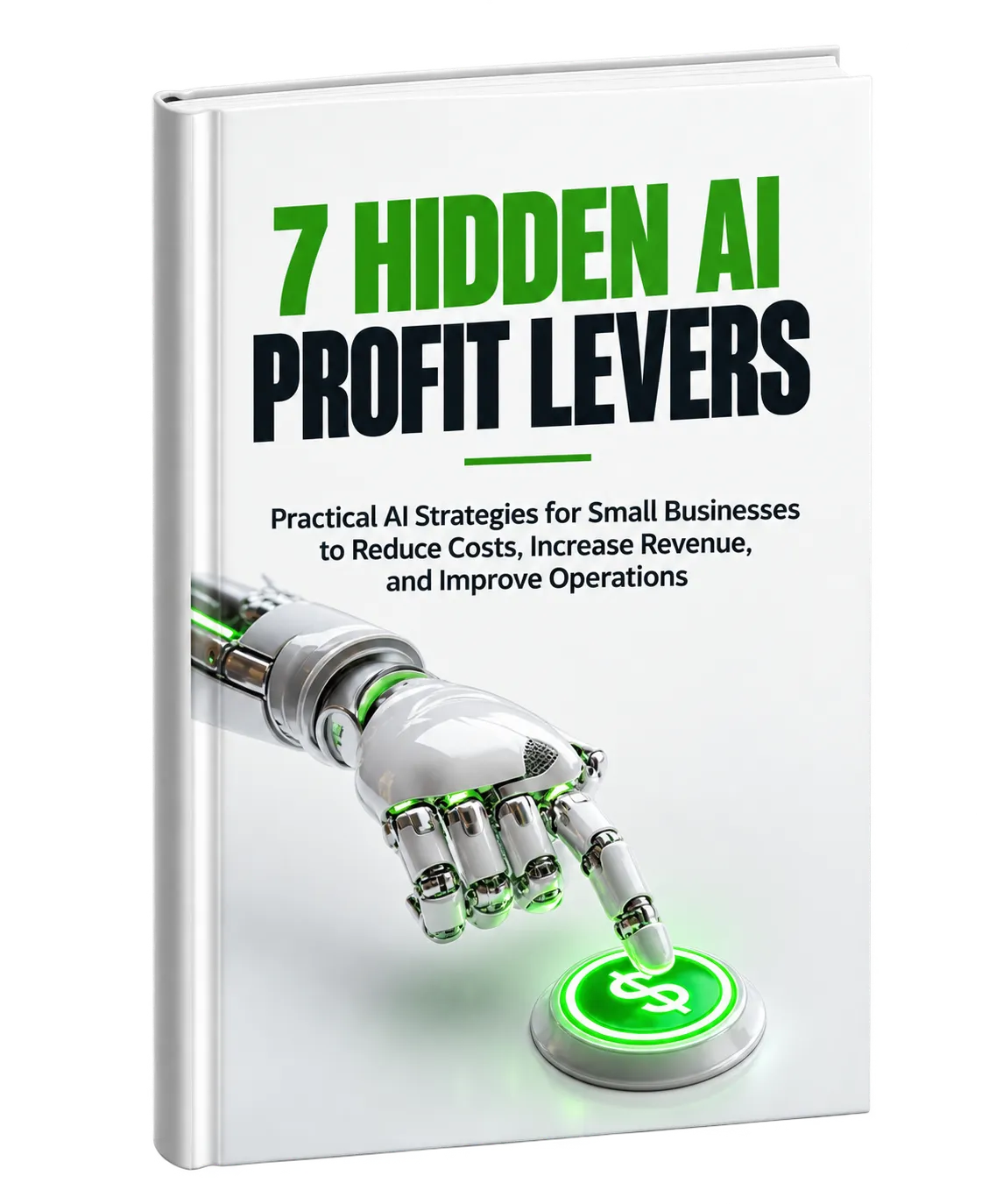
Small businesses often accept certain costs, delays, and manual processes as part of doing business. The resource 7 Hidden AI Profit Levers examines seven areas where AI can be applied to address those challenges.
The focus is not on complex technology or large-scale transformation. Instead, the guide presents practical applications across customer service, inventory, advertising, pricing, content, customer retention, and workflow automation. Each area represents a different opportunity to improve how a business captures revenue, manages resources, or operates day to day.
The resource's central approach is to identify a specific business problem, apply an appropriate AI-enabled solution, and build from there. Rather than attempting to implement everything simultaneously, the guide recommends selecting one opportunity that addresses the business's biggest current challenge.
1. AI-Powered Customer Service After Hours
Customer activity does not stop when a business closes. The resource highlights AI-powered customer service as a way to continue engaging prospects and customers outside normal business hours.
Modern AI chatbots can do more than answer frequently asked questions. According to the resource, they can engage prospects in conversations, schedule appointments, and process orders while a business is offline.
Start With Common Customer Questions
The recommended starting point is simple: identify the ten most common customer questions and configure the AI assistant to handle those first. The system can then be expanded as the business learns what customers need.
The resource also emphasizes transparency. Customers should know when they are communicating with an automated assistant, particularly when the alternative is waiting hours for a response.
2. Predictive Inventory Management
Inventory creates a difficult balance for businesses. Excess stock ties up cash and can create storage or waste costs, while insufficient inventory can result in stockouts and lost customers.
The resource describes AI-powered inventory management as an approach that analyzes sales history, seasonal patterns, supplier timelines, and external factors such as local events to help predict what inventory will be needed and when.
Use Historical Data to Improve Predictions
The guide recommends providing inventory systems with as much relevant historical information as possible, including past sales patterns, seasonal fluctuations, and supplier performance. For businesses operating across multiple locations, the resource also describes coordinating inventory across locations so products are positioned where demand exists.
3. Micro-Targeted Advertising Optimization
Advertising becomes more efficient when businesses can identify the audiences most likely to convert. The resource presents AI-driven micro-targeting as a way to analyze customer data and identify more specific customer segments.
Rather than relying only on assumptions about who the best customers are, AI systems can examine patterns involving purchasing times, interests, browsing behavior, and content engagement.
Consolidate Data Around Valuable Outcomes
The recommended starting point is to combine relevant information such as purchase history, website behavior, email engagement, and demographic information. Businesses can then provide clear conversion goals, such as purchases, lead forms, calls, or store visits, so optimization focuses on meaningful outcomes.
4. Automated Competitor Price Monitoring
Pricing decisions can become outdated when businesses rely on occasional manual competitor checks. The resource describes automated price monitoring as a way to turn competitor pricing information into ongoing competitive intelligence.
AI-powered systems can scan competitor websites, marketplaces, and other sources for pricing changes and provide alerts when significant movements occur.
Look Beyond Price Matching
The resource identifies several uses beyond simply matching competitor prices, including monitoring promotional patterns, identifying discount cycles, recognizing new market entrants, examining price elasticity, and receiving strategic recommendations based on defined goals.
For businesses using advanced systems that integrate with ecommerce platforms, the resource also describes predefined rules that can support automatic price adjustments during important sales periods.
5. Content Creation on Autopilot
Consistently producing blog posts, social media updates, emails, videos, and other marketing content can become a significant workload for small businesses. The resource presents AI-assisted content creation as a way to increase production without placing all of the execution burden on the business owner.
AI writing assistants can generate social posts, product descriptions, blog articles, and email sequences while adapting to brand voice, industry terminology, and the intended audience.
Combine AI Generation With Human Oversight
The resource recommends a human-AI hybrid approach. AI can produce initial drafts, while people review and edit the material to maintain alignment with the brand and preserve authenticity.
It also highlights content repurposing. A single blog post can be transformed into social snippets, an email newsletter, and video script outlines, allowing businesses to extend the value of existing content.
6. Customer Churn Prediction and Prevention
Customer retention is another area where AI can identify opportunities before a problem becomes a lost customer. The resource describes AI-powered churn prediction as a way to identify customers who may be at risk based on changes in their behavior.
Identify Early Warning Signals
Potential signals described in the resource include decreased purchase frequency, reduced website or app activity, fewer email opens or declining click-through rates, changes in support interactions, and shifts in social media engagement or sentiment.
The guide emphasizes that identifying risk is only the first step. Retention strategies should address the specific concern affecting the customer. A price-sensitive customer may need a different response from someone experiencing support problems.
The resource's key principle is to act while the relationship is still salvageable and ensure the response provides genuine value rather than relying on generic retention campaigns.
7. Workflow Automation Beyond Basic Tasks
Basic automation can handle scheduled posts, autoresponders, and simple templates. The resource identifies a deeper opportunity in automating multi-step processes that involve conditional logic, data analysis, task routing, and basic decision-making.
Advanced workflow automation can evaluate information, determine the next step, route tasks appropriately, and keep processes moving without requiring constant oversight.
Connect Previously Siloed Systems
The resource identifies system integration as a major advantage. When CRM, accounting, project management, and communication systems work together, information can flow without repeated manual transfers.
This can reduce double-entry, lower the likelihood of errors, and create a more unified operational process. The guide also describes potential benefits including reduced administrative work, more consistent execution, continued workflow outside business hours, and the ability to scale without proportional staff increases.
Choosing the Right Profit Lever
The seven opportunities address different business problems, so the most useful starting point depends on where the greatest current challenge exists.
- Customer service: Address customer interactions that happen outside regular business hours.
- Inventory: Improve the balance between available stock and demand.
- Advertising: Focus marketing spend on more relevant customer segments and outcomes.
- Pricing: Monitor competitive changes and respond more strategically.
- Content: Increase content production while retaining human oversight.
- Retention: Identify potential churn signals and respond to customer-specific concerns.
- Workflow: Automate complex, multi-step processes that consume valuable team time.
Start With One Opportunity
The resource concludes that these AI applications are practical opportunities rather than purely futuristic concepts. It recommends starting with one profit lever that addresses the business's biggest current challenge, implementing it, learning from the results, and then moving to the next opportunity.
The complete guide expands on each of the seven approaches with additional examples, reported results, implementation guidance, and suggested tools. Download the full resource to explore all seven AI profit levers in detail.