Look Beyond the Advertised Chatbot Price
A chatbot can appear to be a straightforward way to provide 24/7 customer service, respond to questions, and automate parts of customer support. However, the advertised subscription price does not necessarily represent the complete financial commitment.
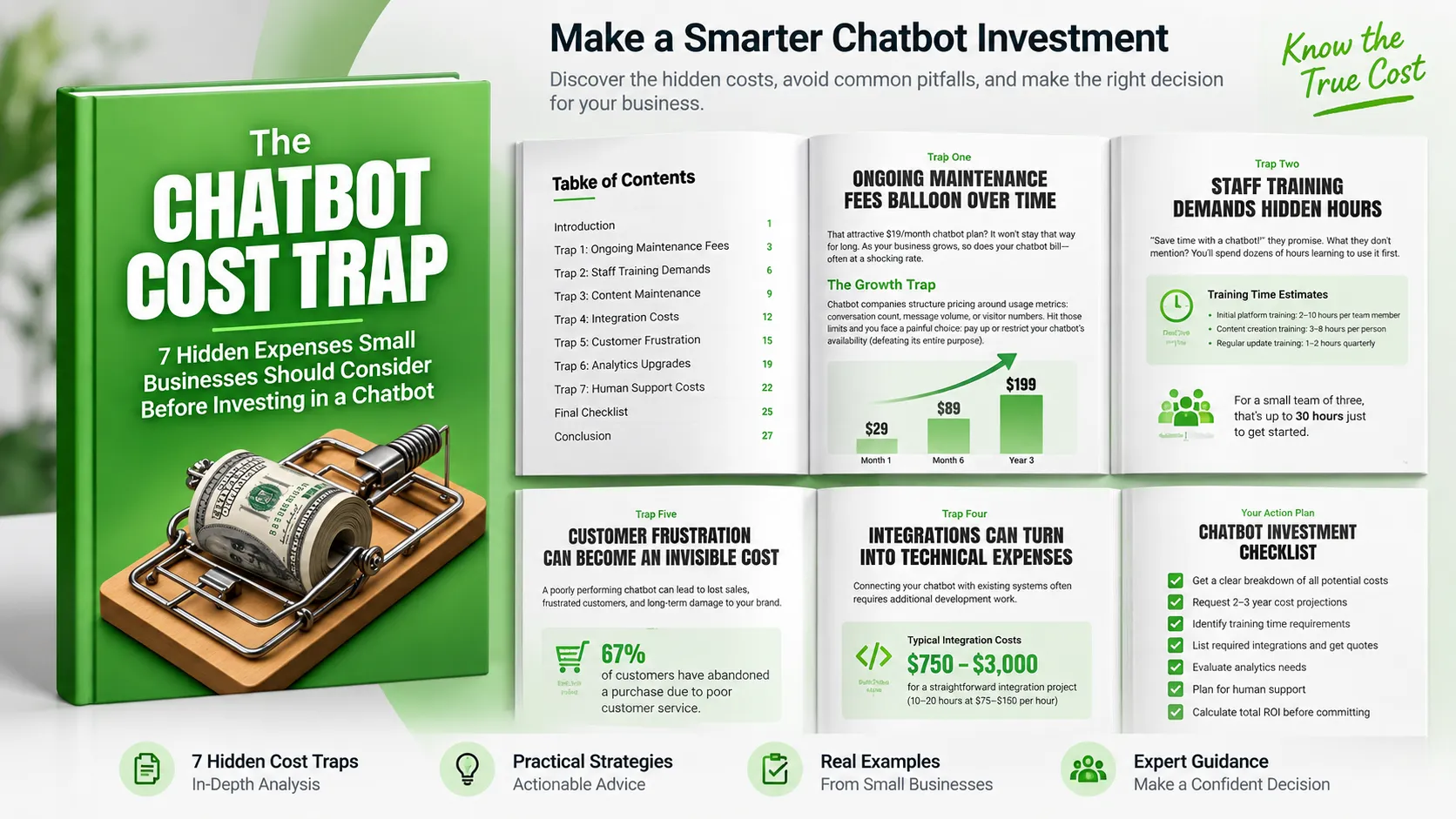
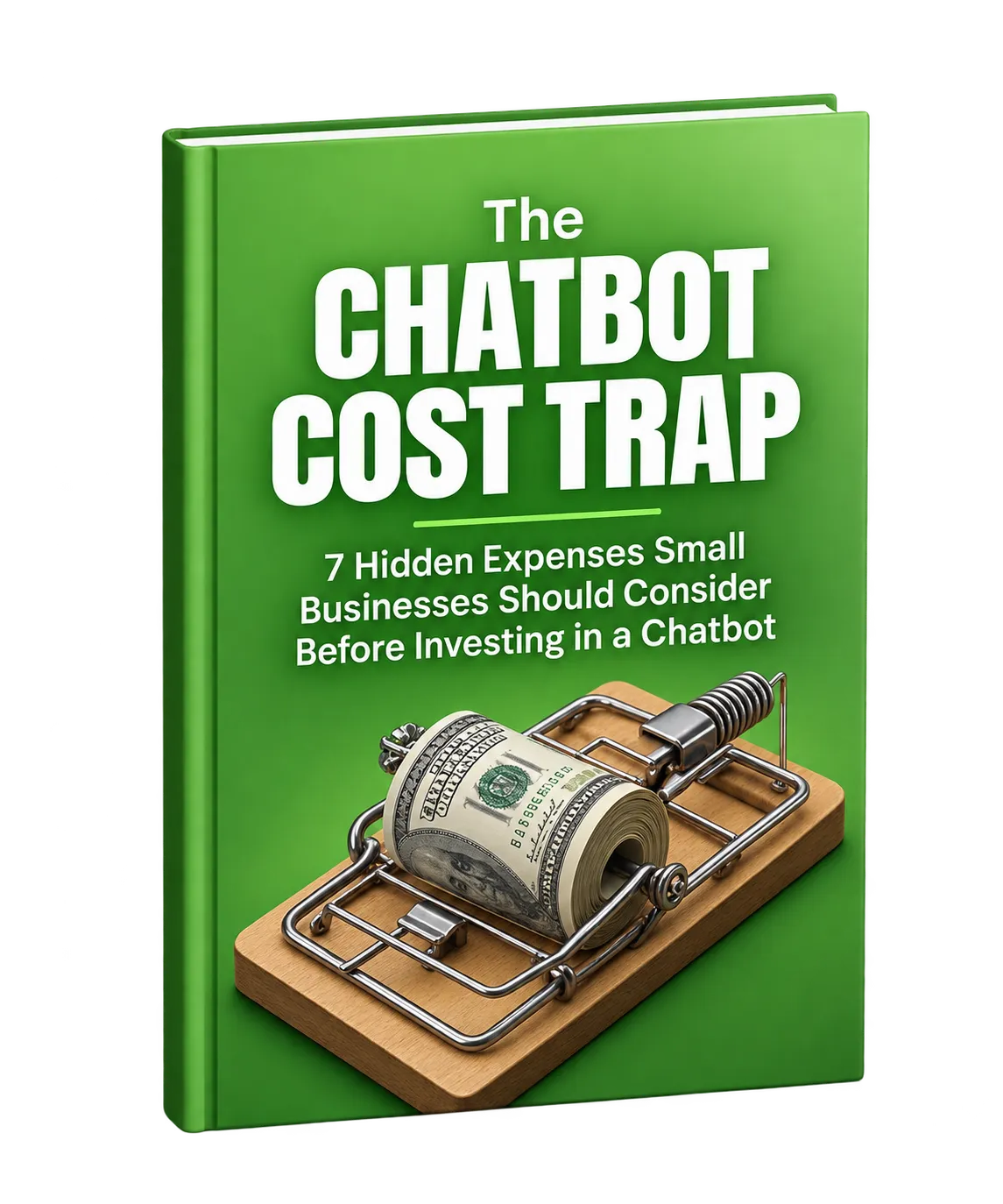
The resource The Chatbot Cost Trap examines seven hidden expenses that small businesses should consider before adopting a chatbot. These costs can appear as the business grows, as employees spend time managing the system, as business information changes, or when the chatbot needs to work alongside existing technology and human support.
The central idea is simple: evaluate the total investment required over time, not just the price shown when you first purchase the service.
1. Ongoing Maintenance Fees Can Increase as Usage Grows
Many chatbot plans are structured around usage metrics such as conversation counts, message volume, or visitor numbers. When usage exceeds the limits of an existing plan, a business may need to pay for a higher tier or restrict chatbot availability.
The resource illustrates this growth problem with a small online store that begins with a $29 monthly plan covering 1,000 chat sessions. After traffic increases, the business moves to an $89 plan and eventually reaches $199 per month. The example demonstrates why the initial subscription price can provide an incomplete picture of long-term cost.
Ways to Protect the Budget
- Ask providers to explain exactly what triggers an upgrade.
- Request case studies showing how costs changed over two or three years for similar businesses.
- Build a multi-year projection that accounts for increasing traffic.
- Consider negotiating limits on percentage-based price increases.
- Ask for reasonable notice periods for future price changes.
2. Staff Training Creates a Hidden Time Cost
A chatbot may save time through automation, but employees still need time to learn how to implement, manage, and maintain the system. That time represents a real business cost, particularly for small teams where employees often handle several responsibilities.
The resource estimates initial platform training at 2 to 10 hours per team member, content creation training at 3 to 8 hours per person, and regular update training at 1 to 2 hours per staff member each quarter. For a three-person team, the initial training requirement can reach 30 hours.
Reducing the Training Burden
- Request detailed training-time estimates before purchasing.
- Consider assigning one chatbot specialist instead of training everyone.
- Look for comprehensive training libraries.
- Negotiate initial training sessions as part of the purchase agreement.
- Create internal documentation that future employees can use.
When calculating ROI, the resource recommends accounting for the hours employees spend learning, managing, and troubleshooting the chatbot rather than counting only the time saved through automation.
3. Chatbot Content Requires Continuous Investment
A chatbot cannot simply be configured once and left unchanged. Businesses regularly introduce products, change prices, update policies, and run promotions. These changes can require corresponding updates to the chatbot's knowledge and responses.
The resource describes this as a continuing content maintenance burden. For a typical small business, it estimates 2 to 5 hours of monthly maintenance, with additional work possible during major changes such as product launches or seasonal transitions.
At the $25 per hour skilled staff rate used in the resource, this represents an estimated $600 to $1,500 annually for basic content maintenance.
Managing the Content Burden
- Establish a regular content review schedule with clear ownership.
- Align chatbot updates with the broader business content calendar.
- Create reusable templates for common responses.
- Limit the chatbot's scope to information that changes less frequently where appropriate.
- Ask whether content update services can be included in the subscription.
Keeping information current is also important for customer experience. Incorrect chatbot responses can damage trust and potentially contribute to lost sales.
4. Integrations Can Turn Into Technical Expenses
A chatbot becomes more useful when it connects with business systems such as a CRM, email platform, ecommerce system, appointment scheduler, or payment processor. However, those connections may require technical work beyond what is included in the base package.
The resource notes that while popular services may offer one-click integrations, businesses using less common systems can encounter additional development requirements. It gives a typical developer rate of $75 to $150 per hour and estimates that a straightforward integration project requiring 10 to 20 hours could cost $750 to $3,000.
Protecting Against Integration Surprises
- Give the provider a complete list of existing systems.
- Get written confirmation about which integrations are genuinely turnkey.
- Obtain upfront quotes for custom development.
- Consider simpler solutions with stronger native integrations.
- Include at least a 20% budget buffer for technical challenges.
Integration requirements should therefore be investigated before committing to a chatbot rather than after implementation has already begun.
5. Customer Frustration Can Become an Invisible Cost
One of the most difficult chatbot expenses to see on an invoice is the potential revenue impact of poor customer experiences. Misunderstood questions, limited capabilities, and weak handoff processes can create friction for customers.
The resource highlights several possible consequences, including abandoned purchases, reduced customer lifetime value, and reputation damage. It also provides examples and statistics describing customer expectations, purchase abandonment, repeat-business impact, and the potential effect of chatbot failures on conversion.
Reducing the Risk of Customer Frustration
- Start with a focused scope covering straightforward customer questions.
- Provide clear escalation paths to human support.
- Test the chatbot regularly using actual customer questions.
- Monitor reviews and social media for customer feedback.
- Provide a feedback mechanism within the chatbot.
The resource emphasizes that the purpose of a chatbot should not be limited to reducing support costs. Customer experience also matters, because automation that creates frustration can undermine the savings it was intended to produce.
6. Valuable Analytics May Require Premium Pricing
Basic chatbot analytics may show metrics such as conversation counts and average session length. However, businesses may need deeper information to understand customer journeys, identify drop-off points, examine sentiment patterns, segment users, and understand which interactions produce useful business outcomes.
According to the resource, premium analytics packages can add 30% to 50% to a monthly subscription. Without access to meaningful insights, teams may also spend time analyzing limited information or make optimization decisions without the data they actually need.
Evaluating Analytics Costs
- Request a detailed comparison of analytics at every pricing tier.
- Ask for a temporary premium analytics trial.
- Calculate the annual cost difference between tiers.
- Negotiate for important reports to be included in the base package.
- Evaluate whether third-party analytics can provide the required insights at a lower cost.
The key consideration is to identify which insights can actually improve the business and ensure the chosen solution provides access to them without creating an unexpected cycle of upgrades.
7. Human Support May Still Be Necessary
A chatbot does not necessarily eliminate the need for human customer support. The resource explains that complex questions, emotionally charged situations, unique scenarios, multiple questions in one message, and requests requiring access to unintegrated systems can still require human intervention.
This creates a dual-system cost structure. A business may pay for the chatbot while continuing to pay for customer service representatives, staff monitoring, and management oversight.
The resource estimates chatbot subscriptions at $30 to $200 per month in the example presented and states that chatbots successfully handle only about 30% to 40% of customer support interactions without human intervention.
Managing the Human and AI Combination
- Define exactly which interactions the chatbot should handle.
- Create a smooth escalation path from the chatbot to human support.
- Use the chatbot for specific, well-defined use cases.
- Document common escalation scenarios.
- Review chatbot failures regularly to identify opportunities for improvement.
The resource recommends treating the chatbot as a complement to human support rather than assuming it will completely replace it. Clearly defining which interactions belong to each channel can help manage the cost of maintaining both systems.
Calculate the Total Cost Before You Commit
The seven cost traps demonstrate why a chatbot should be evaluated as a broader business investment rather than simply as a monthly software subscription.
- Rising subscription costs as usage increases
- Employee training and management time
- Ongoing content maintenance
- Technical integration expenses
- Potential revenue loss caused by customer frustration
- Premium analytics costs
- Continued human support requirements
A meaningful cost-benefit analysis should account for these expenses and the resources required to operate the chatbot over time. The resource also recommends setting realistic expectations about what a chatbot can and cannot handle for a particular business.
Start With the Customer Interactions You Want to Automate
The final recommendation is to begin with the business problem rather than the technology. Determine which customer interactions you want to automate, then evaluate solutions specifically designed for those use cases.
A chatbot can deliver real value when implemented with a clear understanding of the total investment required. The businesses that make better decisions are not necessarily the ones choosing the most feature-heavy technology. They are the ones that understand the complete cost picture and plan accordingly.
Download the complete The Chatbot Cost Trap resource to explore all seven hidden expenses, the examples behind them, and the practical steps provided for managing each one.