Blogs / Why AI Media Tools Still Require Human Direction
Why AI Media Tools Still Require Human Direction
Klyra AI / February 1, 2026
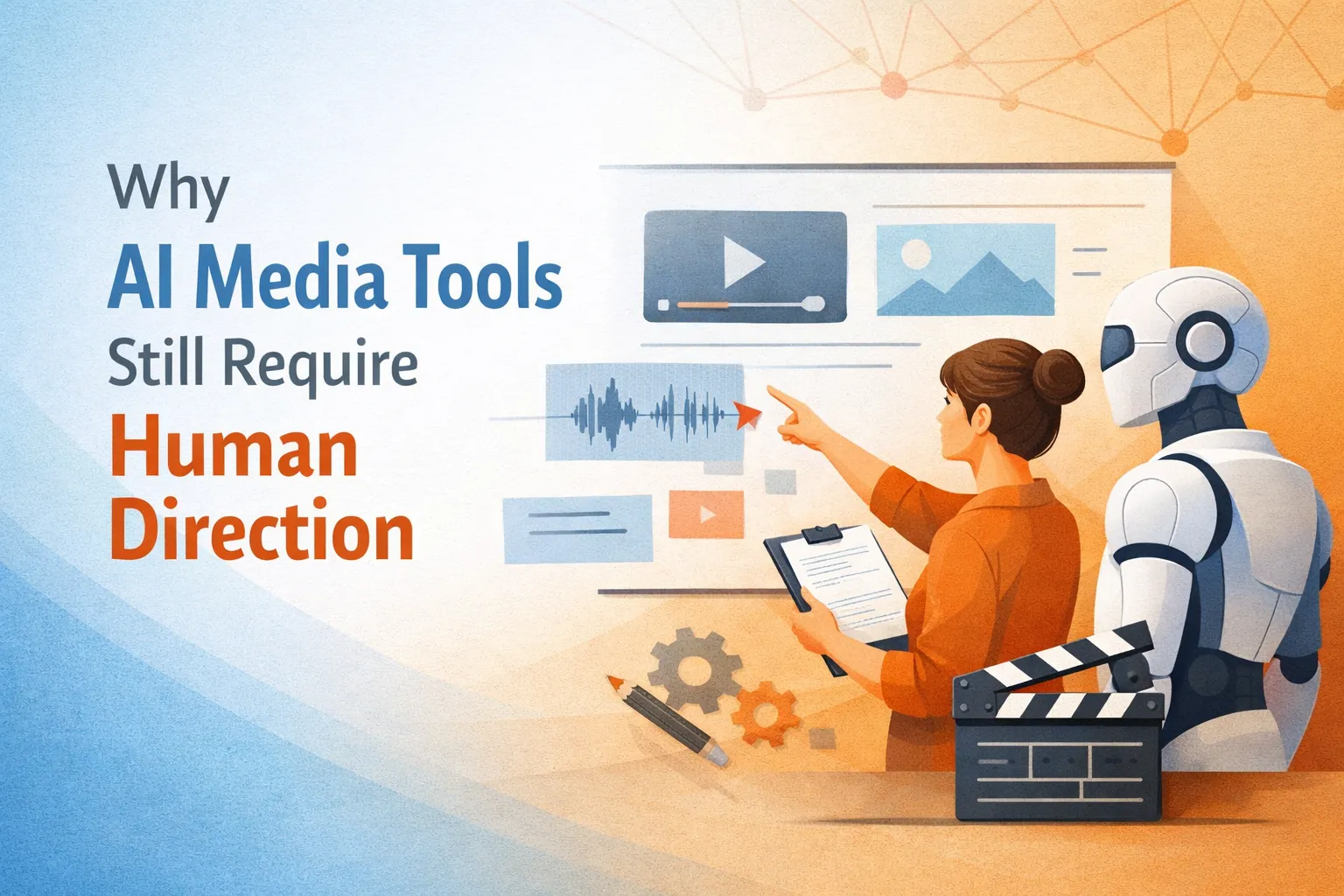
AI media tools have advanced at an extraordinary pace. Text becomes video, images animate into scenes, voices are synthesized, and music is generated on demand. For many teams, this feels like a fundamental shift in how creative work happens.
What often gets lost in the excitement is a quieter truth. While AI can generate media, it does not define meaning, intent, or relevance. Those responsibilities still sit firmly with humans.
As AI media creation becomes more accessible, understanding where automation ends and direction begins becomes essential for anyone using these tools professionally.
The Illusion of Fully Automated Creativity
AI media tools create the impression that creativity itself has been automated. With a prompt and a few settings, complex outputs appear almost instantly.
In reality, what has been automated is execution, not authorship. AI assembles patterns based on instructions. It does not understand narrative goals, audience expectations, or contextual nuance.
When results fall short, the issue is rarely technical failure. It is usually a lack of clear direction.
Automation without intent produces output, not outcomes.
Why Direction Matters More as Tools Improve
As AI models improve, they become more fluent and more convincing. This increases risk as much as capability.
High-quality visuals or videos can mask weak storytelling, unclear messaging, or misaligned tone. The output looks professional, but the communication fails.
Human direction provides the framing AI lacks. It defines purpose before generation and evaluates effectiveness after.
The better the tool, the more important this layer becomes.
Where AI Media Tools Excel
AI media systems excel at speed, variation, and scalability. They reduce production barriers and enable rapid iteration.
For businesses, this means faster prototyping, localized variations, and cost-effective production of supporting assets.
When used with clear constraints, AI media tools amplify creative teams instead of replacing them.
They handle execution so humans can focus on decisions.
Where AI Media Tools Fall Short
AI struggles with subjective judgment. It cannot reliably decide what is appropriate, persuasive, or strategically aligned.
Subtle brand cues, cultural context, and emotional pacing remain difficult to encode fully into prompts.
Without oversight, outputs drift toward generic styles and predictable compositions, especially at scale.
Consistency requires direction, not generation.
The Role of Human Judgment in Media Workflows
Human direction enters at multiple stages. It begins with defining the objective and audience. It continues through evaluation, selection, and refinement.
Professionals decide which variations matter, which outputs align with brand standards, and which should never be published.
AI cannot make these calls responsibly because it does not bear consequences.
Judgment is inseparable from accountability.
Professional Use Cases Demand More Control
Casual experimentation tolerates inconsistency. Professional communication does not.
Marketing, training, education, and public-facing content all carry expectations around accuracy, tone, and clarity.
In these contexts, AI media tools must operate inside controlled workflows rather than open-ended experimentation.
Human review is not optional. It is foundational.
AI Media as an Accelerator, Not an Originator
The most effective teams treat AI media tools as accelerators of creative intent.
They begin with clear direction, use AI to explore execution options, and apply human judgment to select and refine outputs.
This model preserves creativity while benefiting from automation.
The mistake is expecting the tool to originate meaning.
Why Oversight Improves Quality Over Time
Human direction creates feedback loops. Teams learn which prompts work, which styles resonate, and which constraints improve consistency.
Over time, this produces better results with less effort. AI becomes easier to use because expectations are clearer.
Without oversight, teams repeat mistakes faster.
Speed amplifies both strengths and weaknesses.
AI Media Tools Inside Structured Platforms
Tools like Klyra AI Video Generator are most effective when embedded into structured creative workflows rather than used in isolation.
When direction, review, and iteration are built into the process, AI-generated media becomes more predictable, consistent, and useful.
The platform matters less than how it is used.
What Research Says About AI and Creativity
Policy research and academic consensus consistently show that AI enhances creative productivity most effectively when humans retain control over goals, evaluation, and final decisions.
AI systems expand the range of possible outputs, but humans remain responsible for determining relevance, quality, intent, and meaning.
The Real Future of AI Media Creation
The future of AI media creation is not hands-free creativity. It is guided collaboration between humans and machines.
AI will continue to improve at execution. Humans will remain responsible for meaning, intent, and accountability.
Organizations that understand this distinction produce better work with less friction.
AI changes how media is made. It does not change who decides why it matters.