Blogs / The Real Productivity Gains From AI and Where They Plateau
The Real Productivity Gains From AI and Where They Plateau
Klyra AI / February 3, 2026
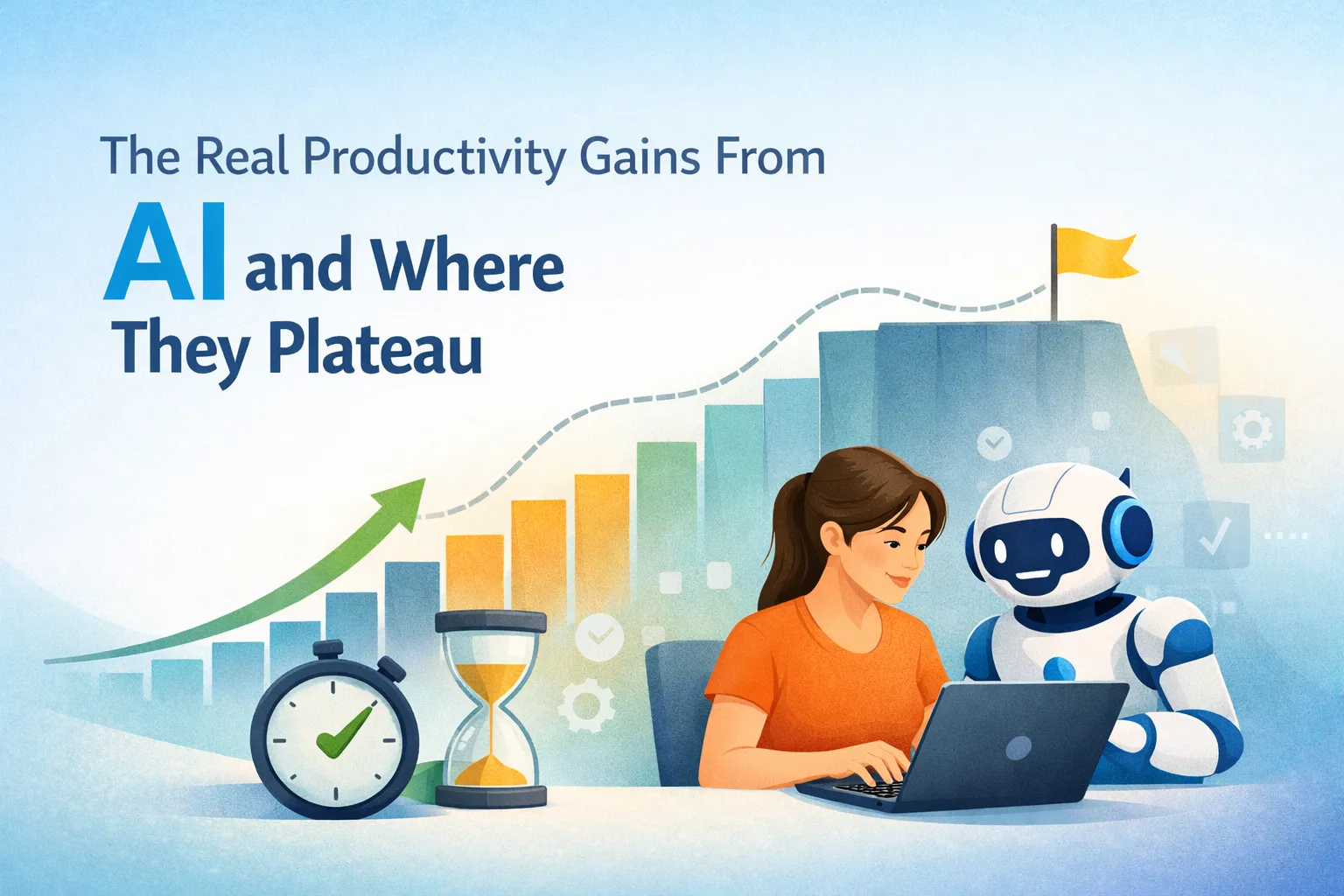
AI entered the workplace with a promise that felt irresistible.
Faster work. Fewer bottlenecks. More output with less effort. For many professionals, those promises initially came true. Tasks that once consumed hours were completed in minutes. Research accelerated. Drafting became effortless.
Then something unexpected happened.
Productivity stopped increasing.
Not because AI failed, but because its benefits reached a natural limit. Understanding where AI delivers real gains and where those gains plateau is essential for anyone who wants to use it effectively rather than optimistically.
Why Early AI Productivity Gains Feel So Dramatic
The first interaction most people have with AI is transformational. Summaries appear instantly. Ideas materialize on demand. Repetitive tasks disappear.
These gains feel dramatic because they target the most inefficient parts of knowledge work. AI removes friction from activities that were previously manual, fragmented, or cognitively expensive.
Research synthesis, content drafting, data extraction, and pattern recognition all benefit immediately. In these areas, AI replaces time-consuming effort with near-instant output.
The result is a sharp productivity spike. But spikes are not the same as sustained growth.
Productivity Is Not Output, It Is Outcomes
The mistake many teams make is equating output with productivity.
AI increases output almost automatically. More documents. More ideas. More analysis.
But productivity is measured by outcomes. Better decisions. Faster execution. Improved quality.
As output increases, teams often discover a new bottleneck. Reviewing, validating, and applying AI-generated work still requires human attention. The time saved upstream reappears downstream.
This is where the productivity curve begins to flatten.
Where AI Continues to Deliver Strong Gains
AI remains highly effective in specific domains even after the initial novelty fades.
Tasks that benefit most share common traits. They are information-heavy, pattern-based, and constrained by clear inputs and outputs.
Examples include literature reviews, document analysis, meeting summarization, first-draft creation, and exploratory research.
In these areas, AI consistently reduces time spent without significantly increasing risk. Used correctly, it allows professionals to operate at a higher baseline speed.
The gains are real and durable, but they are not infinite.
Why Productivity Plateaus Are Inevitable
AI does not eliminate complexity. It redistributes it.
As AI accelerates execution, decision-making becomes the dominant constraint. Humans still decide what matters, what to trust, and what to act on.
Judgment-heavy tasks resist automation. Strategic choices, ethical considerations, contextual understanding, and accountability cannot be delegated without consequences.
Once AI has optimized the mechanical aspects of work, progress slows. Additional automation produces diminishing returns or introduces new risks.
This plateau is not a failure. It is a boundary.
The Hidden Cost of Over-Automation
When teams push AI beyond its productive range, negative effects emerge.
Over-automation can reduce critical thinking. When answers arrive too easily, scrutiny declines. Errors become harder to detect because outputs sound confident and complete.
Cognitive offloading increases. Professionals may disengage from the underlying problem, weakening long-term expertise.
In some cases, productivity appears to increase while effectiveness decreases. Work moves faster, but decisions worsen.
These costs are subtle and often invisible until outcomes suffer.
Why More AI Does Not Always Mean More Efficiency
There is a tipping point where adding more AI tools complicates workflows rather than simplifying them.
Context switching increases. Outputs fragment across systems. Coordination overhead grows.
Instead of saving time, teams spend energy managing AI outputs, reconciling inconsistencies, and revalidating results.
True productivity gains come from integration and clarity, not tool accumulation.
Measuring Productivity Beyond Time Saved
Time savings are easy to measure. Value creation is not.
Organizations that rely solely on speed metrics often misjudge AI’s impact. Faster completion does not guarantee better results.
More meaningful indicators include decision quality, error reduction, consistency, and long-term performance stability.
Tools like the SEO Performance Analyzer illustrate this distinction clearly. Publishing faster does not matter if content performance declines. Measurement must reflect outcomes, not activity.
What Research Suggests About AI and Productivity
Independent research increasingly supports a nuanced view.
Studies from organizations like the Organisation for Economic Co-operation and Development show that AI boosts productivity most effectively when it complements human skills rather than replaces them.
The highest gains occur when AI supports learning, decision preparation, and execution, while humans retain control over judgment and responsibility.
This alignment explains why productivity plateaus are not signs of failure, but indicators of proper balance.
How Professionals Should Use AI After the Plateau
Once the initial gains stabilize, the role of AI shifts.
It becomes an assistant rather than an accelerator. A support system rather than a replacement.
At this stage, effectiveness depends less on speed and more on how intelligently AI is integrated into workflows.
Clear boundaries, defined review processes, and intentional use cases preserve value while minimizing risk.
Productivity as a Sustainable System
The most productive professionals do not chase endless optimization.
They design systems that respect human limits and machine strengths.
AI handles volume, recall, and synthesis. Humans handle meaning, priorities, and decisions.
This division of labor produces steady, sustainable productivity rather than volatile bursts followed by decline.
Final Thought
AI delivers real productivity gains. Then it stops delivering more.
Recognizing where that plateau lies is not pessimism. It is maturity.
Used wisely, AI helps professionals work faster, think clearer, and focus on what matters most. Used blindly, it creates motion without progress.
The goal is not maximum automation. It is maximum effectiveness.