A Practical System for More Strategic Content Marketing
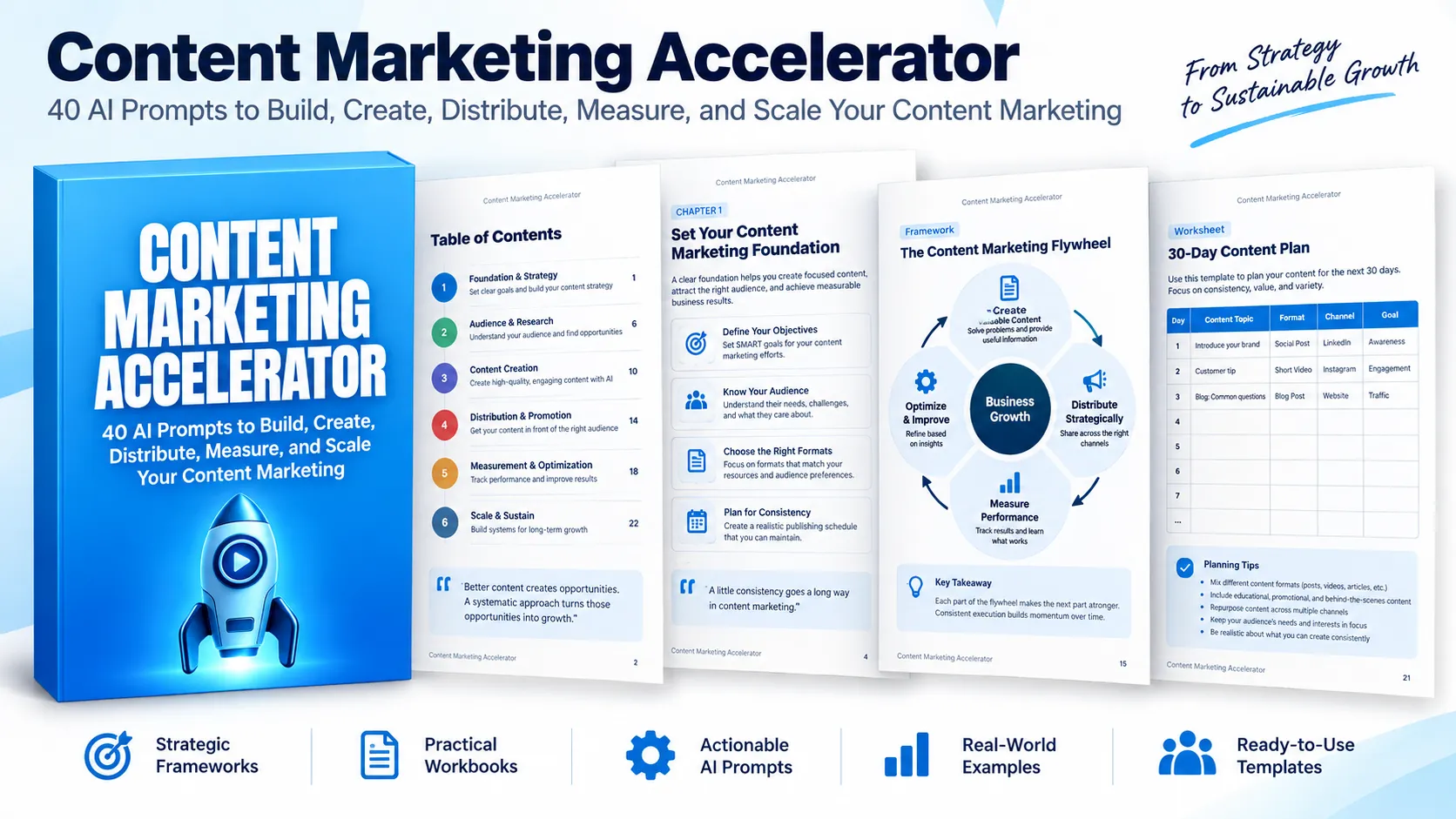
Content Marketing Accelerator is built around a simple idea: content becomes more valuable when it is treated as a strategic business asset rather than a stream of disconnected posts.
The resource brings together 40 AI prompts covering the major activities involved in building, operating, measuring, and scaling a content marketing system. The prompts are designed to help you use an AI assistant as part of the process while keeping your own business context, audience knowledge, and authentic voice at the center.
The complete resource is organized into six connected areas: building your content value engine, understanding your audience, creating consistent content, crafting compelling stories, amplifying your content, measuring what matters, and scaling your content system.
Build a Content Value Engine
The first group of prompts focuses on establishing a strategic foundation. Instead of treating every piece of content as an isolated publication, the prompts help you examine whether your existing content is aligned with business objectives, has lasting potential, is being measured appropriately, and is creating business impact.
The resource introduces a four-phase content value engine:
- Awareness to attract attention from the right audience.
- Engagement to develop interaction with that audience.
- Trust to build confidence through valuable content.
- Action to move people toward the desired business outcome.
Additional prompts address content ROI, evergreen content opportunities, and content repurposing. The repurposing prompt specifically asks an AI assistant to show how one well-researched piece can become at least eight different assets.
Understand Your Audience
Effective content depends on understanding the people it is intended to serve. The audience research section provides prompts for discovering customer challenges, monitoring industry conversations, analyzing competitors, developing detailed personas, and identifying questions your audience is already asking.
Research Audience Needs
The One-Question Research Design prompt helps create an email or social media poll designed to reveal valuable insights about audience challenges. The Social Listening Plan prompt focuses on monitoring conversations across platforms and communities to identify emerging concerns and topics.
Develop Useful Customer Insights
The Detailed Persona Development prompt creates an evidence-based persona using information such as goals, frustrations, content habits, and purchase triggers. The Empathy Map Creation prompt goes further by organizing what an ideal customer says, thinks, does, and feels, then identifying gaps between public statements and private thoughts.
Prioritize Topics
The Content Topic Prioritization prompt uses a serve score formula: (impact × relevance) ÷ effort. This provides a structured way to evaluate potential topics based on audience value, connection to the business, and creation difficulty.
Create Consistent Content
Once the strategic foundation is established, the resource moves into building a sustainable content creation system. The prompts cover SMART content goals, content pillars, quarterly themes, editorial calendars, batch production, and standard operating procedures.
The Realistic Editorial Calendar prompt is designed around maintaining consistency without burnout. It asks for a conservative publishing schedule that balances different content types, aligns content with the value engine, leaves room for timely content, and includes buffer periods for unexpected disruptions.
The Content Batch Production System focuses on grouping similar tasks together, creating reusable templates, maintaining a content bank, and establishing a minimum viable post framework for busy periods.
The Standard Operating Procedures prompt turns recurring content tasks into documented, sequential processes with required tools, quality checks, and time estimates. This creates a foundation for greater consistency and eventual delegation.
Craft Compelling Stories and a Consistent Voice
Content strategy also needs a recognizable voice and an effective way to communicate ideas. The storytelling section helps select appropriate story frameworks for different content topics and goals.
One prompt asks an AI assistant to recommend a suitable framework such as Before-After-Bridge or Problem-Agitate-Solution, explain why it fits, create an outline, and provide an example opening.
The resource also includes a Brand Voice Development prompt for creating a voice chart, defining a one-sentence voice statement, developing representative phrases, and adjusting the voice subtly across channels.
A Content Format Selection Matrix helps determine the primary content format, complementary formats for repurposing, format-specific best practices, and a decision process for selecting formats for future topics. Visual Storytelling Enhancement adds guidance for choosing visuals that support the story and maintaining consistency across platforms.
Amplify and Distribute Your Content
Creating content is only one part of the system. The Amplifying Your Content section focuses on getting useful content in front of the intended audience.
The Owned Channels Optimization prompt creates a promotional sequence across channels you control, including your website and email list. It also addresses website placement, email segmentation, and a repeatable promotion checklist.
The Core-Satellite Channel Strategy uses the resource's 3-2-1 rule to help create a sustainable promotion approach. It considers primary, secondary, and experimental channels, platform-specific adaptations, publishing schedules, and voice adjustments.
The Content Repurposing Workflow then turns a core content piece into multiple platform-specific assets through a structured workflow, status board, and time-blocked production schedule.
Improve Search Visibility
The SEO Enhancement Plan focuses on improving content search visibility without requiring technical expertise. It covers matching keywords to search intent, creating descriptive benefit-focused titles, image alt text, internal linking, and a practical checklist for new content.
The resource also explores Strategic Partnership Outreach and Guest Content Strategy for expanding reach through complementary businesses, guest posts, podcasts, and expert contributions.
Measure What Matters
The measurement section focuses on using data to make better content decisions rather than simply collecting metrics.
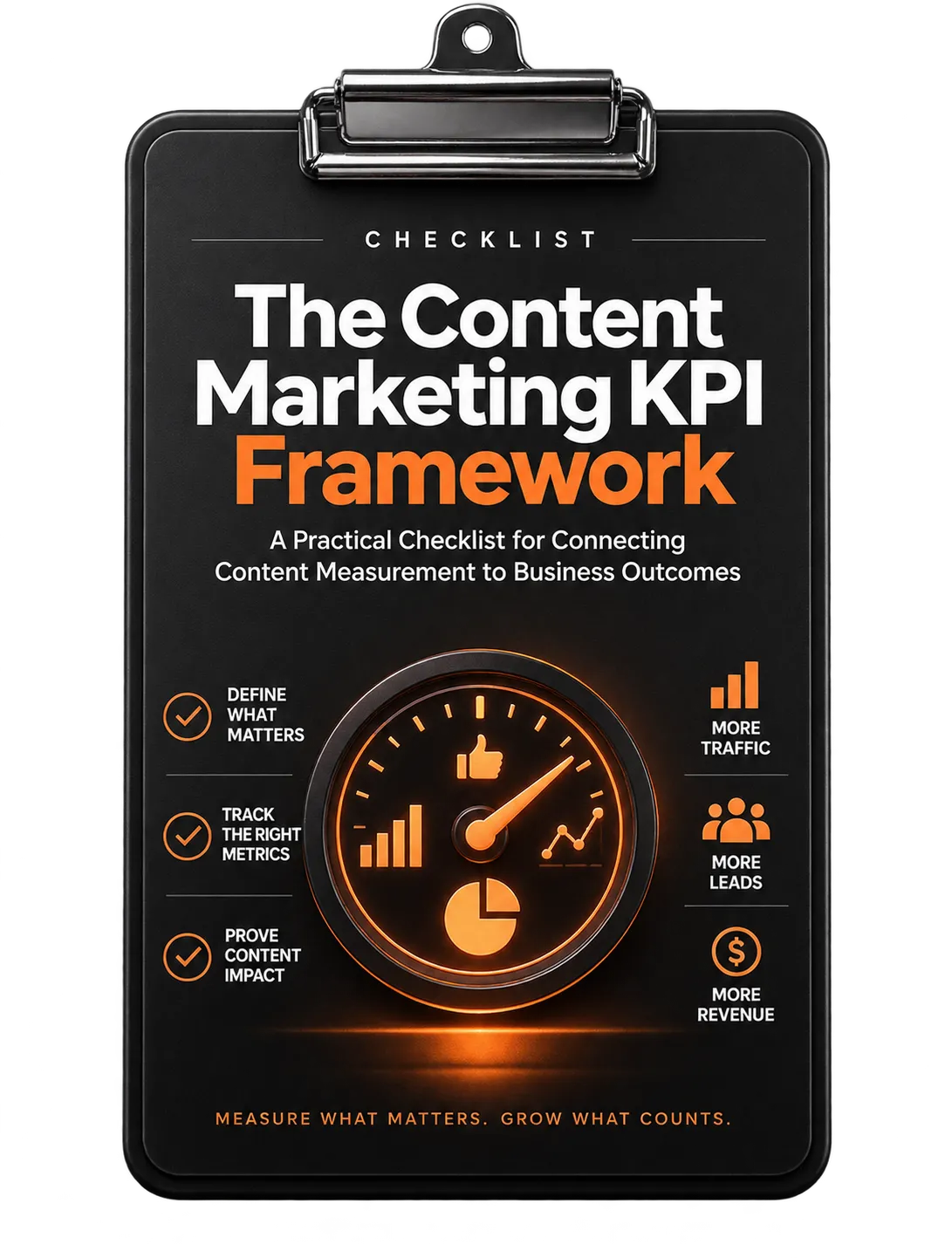
The North Star Metrics Selection prompt centers measurement around three areas: traffic quality, engagement depth, and conversion efficiency. The Simple Dashboard Design prompt organizes content performance into a four-block dashboard and includes guidance for review schedules and conditional formatting.
Turn Data Into Decisions
The Data Interpretation Guide introduces a three-step insight loop: observe, diagnose, act. It also asks for common performance patterns, a business-specific ROI calculation, and a decision tree for determining what content to create next.
The A/B Testing Framework provides a structured approach to incremental improvement, including prioritizing elements to test, creating hypotheses, considering statistical significance, and recording results.
Content Performance Analysis can then be used to review recent content, identify strengths and weaknesses, compare performance with goals and benchmarks, recommend improvements, and identify elements worth replicating.
Scale Your Content System
The final section focuses on maintaining and improving the system as the business grows. The Content Audit Template is designed for a six-month review cycle and covers scoring content, deciding whether to keep, refresh, merge, or retire pieces, and scheduling resulting actions.
Workflow Mapping and Optimization helps identify bottlenecks from concept through publishing and creates a structure for quarterly process reviews.
Strategic Automation Planning identifies content tasks that may be suitable for automation while also addressing safeguards for maintaining authentic connections. The Content Team Expansion Framework addresses delegation, quality consistency, contributor guidelines, and onboarding.
For focused growth, the 90-Day Growth Sprint Design creates a measurable target, monthly themes, weekly priorities, and a review system. When momentum stalls, the Content Momentum Recovery Plan provides diagnostic questions, targeted interventions, a minimum viable content plan, and guidance for separating useful opportunities from distractions.
The Content Marketing Flywheel
The resource's implementation strategy connects these components into a self-reinforcing flywheel:
- Audience research informs content strategy.
- Strategy guides consistent creation.
- Storytelling makes content compelling.
- Distribution helps content reach the audience.
- Measurement identifies what is working.
- Continuous improvement strengthens the entire system.
Each component supports the others, creating a system that can improve over time rather than relying on isolated content activities.
How to Start Using the Resource
The recommended implementation approach begins with assessment and foundation during weeks 1-2, followed by system building during weeks 3-4. Activation and distribution take place during weeks 5-6, followed by ongoing measurement and refinement.
For those who want to begin with a smaller set of prompts, the resource recommends five starting points:
- Content Value Engine Design
- Detailed Persona Development
- Content Pillar and Theme Planning
- Brand Voice Development
- North Star Metrics Selection
The complete resource provides all 40 prompts, including the detailed inputs and outputs to guide each exercise. Use it as a working reference to develop your content foundation, create a repeatable system, improve distribution, understand performance, and plan for longer-term growth.