Use AI to Rethink the Content Creation Workflow
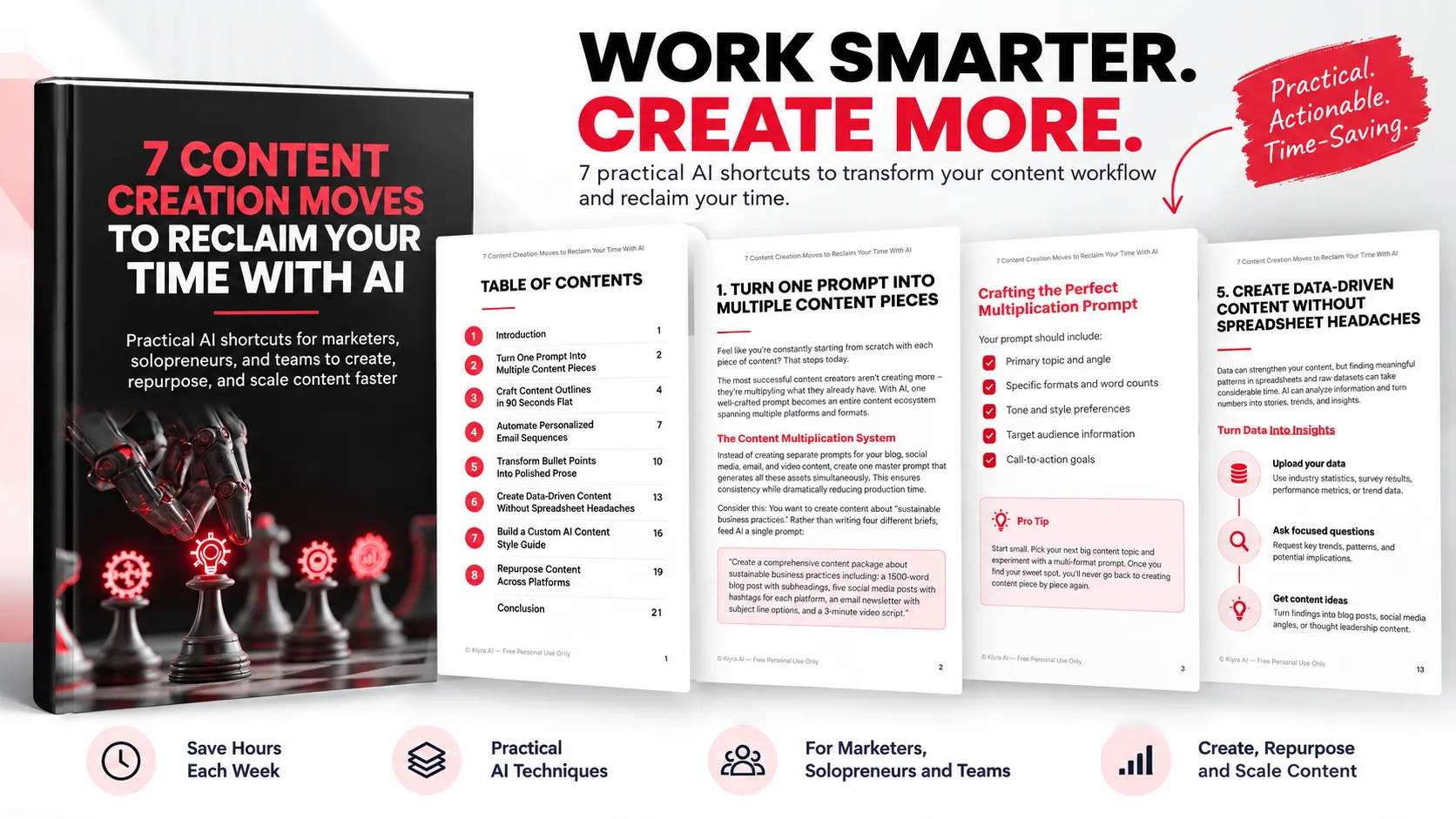
Content creation can become a constant cycle of writing blog posts, preparing social media updates, producing newsletters, and developing videos. The resource presents a different approach: instead of treating every piece of content as a separate project, use AI to reduce repetitive work and multiply the value of ideas you have already developed.
The goal is not to replace your unique voice or expertise. AI is positioned as a content assistant that helps with tasks such as structuring ideas, developing variations, transforming existing material, and identifying patterns in information. Your role remains important in reviewing the output, adding experience, and making the final content your own.
1. Turn One Prompt Into Multiple Content Pieces
One of the central techniques is content multiplication. Instead of writing separate briefs for a blog article, social posts, an email newsletter, and a video, create one master prompt that describes the core topic and asks for multiple formats at once.
A useful multiplication prompt should specify the:
- Primary topic and angle
- Content formats and word counts
- Tone and style
- Target audience
- Call-to-action goals
For example, a single brief about sustainable business practices can request a long-form blog post, several social media posts, an email newsletter with subject-line options, and a video script. The result provides a foundation for content across multiple channels while keeping the material aligned around the same core message.
The resource emphasizes that AI-generated material should become a foundation for your expertise, personal stories, and unique insights rather than the final word.
2. Craft Content Outlines Quickly
Research and outlining can consume a significant amount of the content creation process. The resource recommends giving AI specific information about the target keyword, audience needs, and content goals instead of beginning with a vague request.
A detailed prompt can ask for H2 and H3 headings, statistics that need to be researched, examples to include, and a practical rather than theoretical focus.
Iterate Instead of Accepting the First Outline
The first outline does not have to be the final one. The recommended process is to generate an initial structure, review it for gaps or unnecessary sections, ask AI to expand or remove sections, and request alternative approaches to the same topic.
This makes it possible to explore different angles quickly before committing to the final structure. The human writer can then use their expertise to refine the outline and add the insights that make the finished content useful.
3. Automate Personalized Email Sequences
Personalized email content can require substantial manual work when different audience segments have different needs. The resource recommends starting with clear audience segments based on factors such as purchase history, engagement level, content preferences, or demographic information.
AI can then help create a customized email sequence for each segment. For example, separate sequences can be developed for new subscribers who have not purchased, active customers who purchased recently, and dormant subscribers who have not engaged for an extended period.
The approach becomes more powerful when AI-generated content is combined with an email platform's automation capabilities. Subscriber actions can determine which piece of content they receive next.
Ways to Improve the Email Workflow
- Generate multiple subject-line options for testing.
- Create variations based on different audience pain points.
- Build branching sequences that adapt to subscriber behavior.
The resource recommends starting with one important audience segment, validating the workflow, and expanding it gradually.
4. Transform Bullet Points Into Polished Prose
Writer's block often appears when writers try to produce polished paragraphs before they have captured their ideas. The bullet-to-prose method reverses that process.
Start with simple bullet points containing the core ideas. They do not need to be complete sentences. Once the raw thoughts are captured, provide them to AI with clear instructions about tone, transitions, personal experience, and the desired level of practicality.
This approach can be particularly useful for introductions, conclusions, transitions, explanations of complex concepts, and story-based examples.
The resource stresses that generated prose should be reviewed and refined. Adding personal anecdotes, specific examples, and natural phrasing helps preserve the writer's own voice.
5. Create Data-Driven Content Without Spreadsheet Headaches
Data can strengthen content, but finding meaningful patterns in spreadsheets and raw datasets can take considerable time. The resource presents AI as a way to analyze information and turn raw numbers into potential stories, trends, and insights.
Useful source material can include industry statistics, survey results, performance metrics, or trend data. For example, sales data can be analyzed to identify seasonal patterns, explore possible business implications, consider potential causes, and suggest ways to use the findings.
Connect Multiple Data Sources
The resource also describes combining datasets to identify relationships that may not be obvious when each source is examined independently. Website traffic and social media engagement, for example, can be compared to explore which content is associated with stronger performance across both areas.
For responsible analysis, the resource recommends:
- Verifying AI-generated insights against the original data.
- Asking for multiple interpretations of the same information.
- Requesting specific examples that illustrate each trend.
- Using AI to suggest headlines based on the findings.
6. Build a Custom AI Content Style Guide
Maintaining a consistent brand voice becomes more difficult as content production increases. The resource recommends creating an AI style guide from examples that already represent the desired voice.
Begin with three to five strong examples of existing content. Examine characteristics such as sentence length, vocabulary, level of formality, use of industry terminology, argument structure, storytelling patterns, metaphors, analogies, and examples.
These observations can then be turned into a reusable prompt that teaches AI how the brand communicates. The prompt can ask AI to identify key characteristics, commonly used words and phrases, sentence patterns, content organization, and a summary of the brand voice.
For future content requests, the resulting style guidelines can be placed at the beginning of the prompt. This creates a repeatable system for maintaining tone and style while reducing repeated editing.
7. Repurpose Content Across Platforms
Creating completely different content for every platform can consume significant time. The resource recommends starting with existing content that has already performed well and treating it as source material for additional formats.
Before repurposing, identify the requirements of each destination, including:
- Optimal content length
- Preferred structure and formatting
- Platform-specific features such as hashtags or threads
- Audience expectations and engagement patterns
AI can then transform the source material for each destination while preserving the important ideas. Examples in the resource include turning long-form articles into social threads, blog posts into YouTube scripts, webinar content into email newsletters, podcast episodes into Instagram captions, and case studies into short-form video scripts.
Adapt the Message, Not Just the Format
Effective repurposing should account for what each audience is likely to value. A LinkedIn audience may respond more strongly to business implications, while an Instagram audience may respond better to visual concepts and stories.
The result is not simply duplicated content. It is the same core message adapted to the native requirements of each channel.
Build the System One Shortcut at a Time
The seven approaches work together as a broader content workflow. Content can begin with a multiplied prompt, move into a quickly developed outline, use AI-assisted writing and data analysis, maintain consistency through a style guide, and finally be repurposed across multiple platforms.
The resource recommends resisting the temptation to implement everything at once. Choose one shortcut, implement it during the week, and master it before moving to the next. Each technique can then become part of a more comprehensive approach to content production.
The underlying principle is straightforward: use AI to reduce repetitive work and accelerate production while keeping human expertise, judgment, personal experience, and voice at the center of the finished content.
Download the Complete Resource
This landing page provides an overview of the seven content creation moves. The complete resource includes the detailed methods, prompt examples, implementation guidance, and practical recommendations for putting each technique into practice.
Download the complete resource to work through the seven approaches and choose the first AI shortcut to introduce into your own content workflow.