Local Business Content Marketing
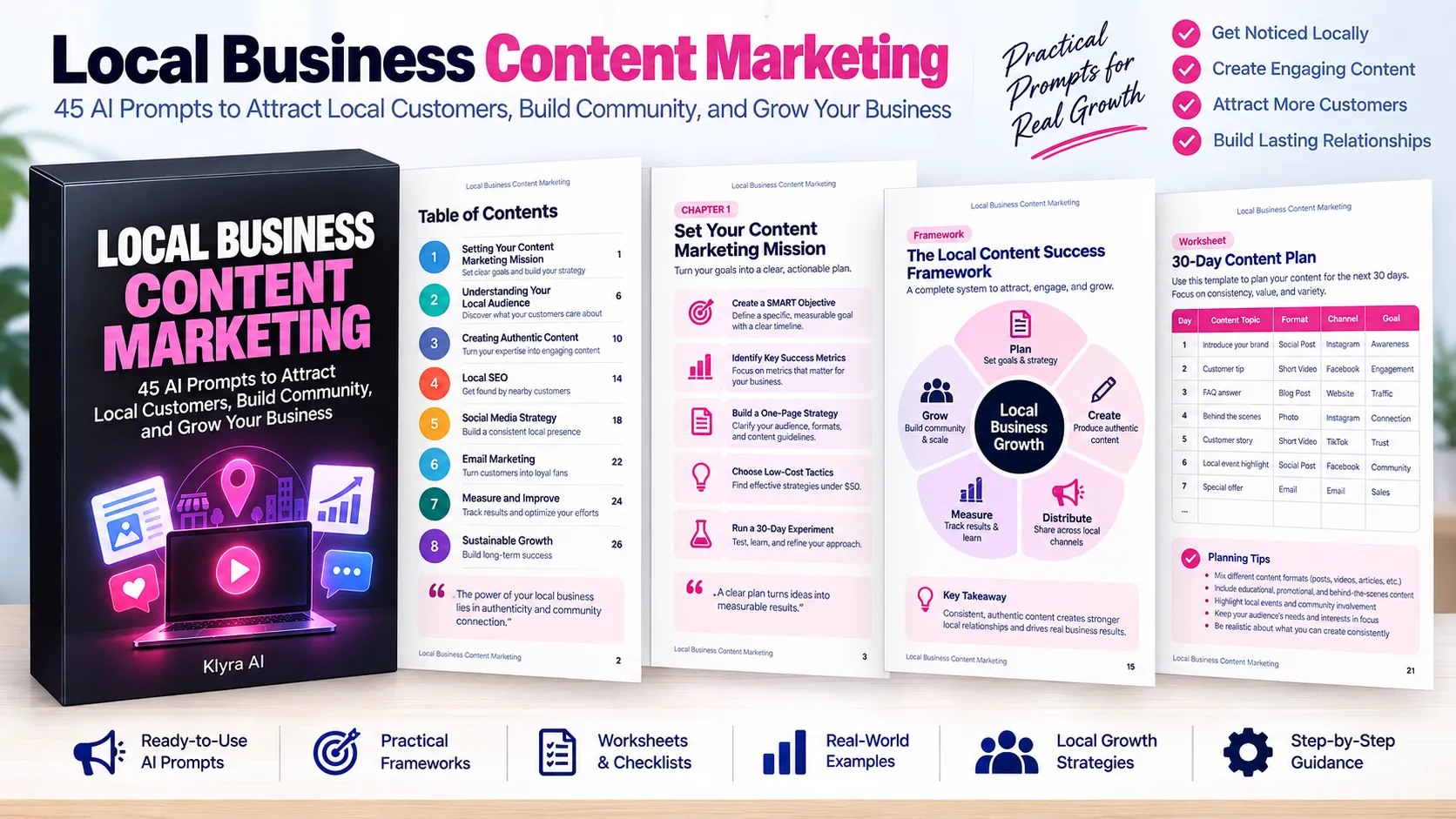
Local Business Content Marketing provides 45 AI prompts designed specifically for small and local businesses that want to use content to attract customers, strengthen community connections, improve local visibility, and generate measurable business results.
The resource is designed around practical implementation rather than complicated marketing systems. It helps businesses establish their objectives, understand their audience, create authentic content, improve Local SEO, build social and email marketing systems, measure performance, and create sustainable marketing habits.
Set Your Content Marketing Mission
Effective content marketing starts with clear objectives, realistic resources, and measurable business outcomes.
Create a SMART Content Marketing Objective
Transform a broad business goal into a Specific, Measurable, Affordable, Relevant, and Time-boxed content marketing objective with a clear timeline and success metrics.
Define Success Metrics Aligned With Business Goals
Identify 3-5 meaningful metrics connected to business objectives rather than focusing on vanity metrics. The prompt also helps determine how to track them using affordable tools.
Content Strategy One-Page Plan
Create a practical one-page content strategy covering the content mission, primary and secondary audiences, content formats, publishing frequency, business-focused metrics, and content guidelines.
Low-Cost Content Marketing Tactics Selection
Identify three affordable content marketing tactics that can be implemented for under $50, including the required skills, tools, time commitment, expected outcomes, and measurement approach.
Content Marketing Experiment Design
Design a 30-day experiment to test whether a specific content tactic can help achieve a defined business goal, including baseline metrics, content production, tracking, customer feedback, and success criteria.
Understand Your Local Audience
The resource emphasizes understanding real customer needs before creating content.
Customer Conversation Question Guide
Create natural questions staff can ask during everyday customer interactions to uncover motivations, preferences, and pain points without disrupting the service experience.
Very Short Customer Survey Design
Create a customer survey that takes less than two minutes and combines numerical ratings with open-ended responses to gather actionable content insights.
Online Local Audience Research Plan
Create a one-hour-per-week research process using sources such as Google Trends, competitor social media and reviews, Facebook groups, Nextdoor, and Google's People Also Ask results.
Customer Feedback Pattern Analysis
Analyze customer comments and questions to identify recurring themes, customer language, unexpected insights, and content opportunities for the following month.
Neighborhood Interest Mapping
Research the interests and needs of a business's local area, including demographic characteristics, local search terms, neighborhood events, purchasing influences, and gaps in local services.
Create Authentic Content
Local businesses have an advantage that larger brands often cannot replicate: authentic relationships with customers and communities.
Phone Video Script Template
Create a repeatable 60-second smartphone video structure with a strong opening hook, product or service demonstration, benefits, visual guidance, and a clear call to action.
Blog Post From Customer Questions
Transform common questions customers ask into useful blog content that demonstrates expertise while using natural language that reflects how customers actually communicate.
Visual Content Planning Calendar
Create a four-week visual content plan that can be executed using a smartphone, including photo and video concepts, production tips, posting schedules, repurposing opportunities, and customer photo-sharing ideas.
DIY Production Quality Improvement
Analyze an existing content production setup and identify affordable improvements that can improve lighting, audio, video quality, or other production challenges.
User-Generated Content Campaign Design
Design a seven-day UGC campaign that encourages customers to create and share content, including campaign concepts, customer prompts, incentives, implementation steps, permissions, repurposing, and measurement.
Behind-the-Scenes Content Series
Create a month-long behind-the-scenes series that reveals interesting aspects of business operations while connecting each story to customer benefits.
Customer Story Spotlight Template
Create a repeatable framework for highlighting customer experiences, including interview questions, permission requirements, emotional and practical benefits, visual elements, and distribution options.
Improve Local SEO
The Local SEO section focuses on helping businesses become more visible to customers searching within their geographic market.
Local Keyword Research Guide
Create a step-by-step process for finding hyperlocal keywords, discovering the language customers actually use, evaluating local competition, organizing keyword research, and prioritizing keywords by search intent.
Google Business Profile Optimization Checklist
Create a comprehensive checklist covering profile completion, categories and attributes, photos, Q&A management, reviews, weekly posts, and business-specific features.
Hyperlocal Landing Page Structure
Create a neighborhood-specific landing page structure containing local signals, optimized headings, content sections, schema recommendations, on-page SEO elements, and local trust signals.
Local Content Calendar With SEO Focus
Create a three-month content calendar connecting seasonal relevance with local search opportunities, including content titles, formats, target keywords, and local visibility objectives.
Local Business Schema Markup Generator
Generate JSON-LD structured data using business information such as the business name, address, phone number, hours, services, payment methods, and social profiles, along with simple implementation guidance.
Build a Local Social Media Strategy
The social media prompts focus on choosing the right channels and building consistent engagement without requiring a large time investment.
Platform Selection Analysis
Evaluate major social platforms according to audience fit, content requirements, time investment, and potential for driving local visits, then identify primary and secondary platforms.
One-Hour-a-Week Social Media Routine
Create a detailed weekly social media routine that divides one hour between content creation, scheduling, engagement, and analysis.
Local Social Media Engagement Strategy
Build an engagement strategy focused on relationships with local businesses, influencers, neighborhood groups, customers, and community members rather than simply broadcasting promotional posts.
Social Media Content Pillar Development
Develop 3-5 recurring content pillars that align business objectives with audience interests while naturally connecting content back to the business.
Local Hashtag and Geotag Research
Identify location-based and niche hashtags, relevant geotags, and a simple system for testing and measuring their effectiveness.
Social Media Caption Formula
Create a reusable caption framework covering attention-grabbing openings, benefit-focused or story-based middle sections, local calls to action, engagement questions, and natural local references.
Build an Email Marketing System
Email marketing provides local businesses with an owned channel for building ongoing customer relationships.
Email List Growth Tactics
Develop practical in-store tactics for growing an email list without disrupting the customer experience, including incentives, implementation steps, compliance considerations, and signup-quality measurement.
Welcome Email Sequence Design
Create a three-email welcome sequence that gradually builds trust before introducing offers, incorporating local and personal elements throughout the sequence.
Email Segmentation Strategy
Identify meaningful customer segments, determine how subscribers belong to each segment, develop relevant messaging, and measure whether segmentation improves results.
Automated Email Trigger Design
Design automated email triggers based on customer actions or important points in the customer journey, with relevant content, offers, personalization, implementation steps, and measurement.
Email Content Formula for Local Businesses
Create a repeatable newsletter formula that balances community building with soft selling through neighborhood relevance, customer stories, social proof, local calls to action, and mobile-friendly design.
Measure and Improve Performance
The resource treats measurement as a practical improvement system rather than a complex analytics exercise.
Simple Analytics Dashboard Design
Design a simple weekly dashboard focused on business-relevant metrics that can be managed without advanced technical skills.
Monthly Content Performance Review Process
Create a 30-minute monthly review process for evaluating what worked, what did not, how content influenced business results, and what should change in the next month's plan.
A/B Testing Plan for Local Content
Develop three practical A/B tests covering elements such as calls to action, images, and posting times, including setup, duration, measurement, and application of the findings.
Content ROI Calculation Method
Create a straightforward approach to estimating content marketing ROI without requiring complex attribution models.
Content Marketing Pivot Decision Framework
Develop a framework for deciding whether content performance problems require execution improvements, small experiments, or a broader strategic pivot.
Build Sustainable Growth
The final section helps local businesses turn individual marketing activities into sustainable long-term systems.
Quarterly Content Planning Retreat Guide
Design a half-day quarterly planning session covering performance evaluation, goal setting, decision documentation, team participation, and implementation.
Content Skills Development Plan
Create a 90-day plan for developing practical content marketing skills through affordable learning resources, real business exercises, measurement, and manageable weekly commitments.
Content Repurposing Maximizer
Transform one core content asset into multiple pieces across different channels while minimizing additional work and tracking which variations perform best.
Content Collaboration Strategy
Develop partnerships with complementary local businesses through mutually beneficial content collaborations, cross-promotion, and measurable shared outcomes.
Annual Content Calendar Framework
Create an annual content framework based on business seasonality, local community events, evergreen content pillars, changing content volume, and annual review milestones.
Sustainable Content Habits Formation
Build realistic content creation habits around existing business responsibilities while reducing perfectionism and procrastination and improving consistency over time.
Future-Proof Content Strategy
Create a content strategy designed to remain useful as social platforms and algorithms change by focusing on evergreen principles, durable content assets, platform diversification, trend evaluation, and new-platform assessment.
Implementation Strategy
The resource does not recommend trying to use all 45 prompts simultaneously. Instead, it provides a structured 12-week implementation path. :contentReference[oaicite:1]{index=1}
Weeks 1-2: Foundation and Planning
- Set the SMART content objective.
- Define success metrics.
- Create the one-page content strategy.
Weeks 3-4: Audience Research
- Develop a customer conversation strategy.
- Conduct online local audience research.
- Analyze customer feedback patterns.
Weeks 5-6: Content Creation Basics
- Create the first content piece.
- Improve production quality.
- Plan the first content series.
Weeks 7-8: Distribution Fundamentals
- Research local keywords.
- Optimize the Google Business Profile.
- Select the primary social platform.
Weeks 9-10: Engagement Systems
- Establish the weekly social media routine.
- Implement email list growth tactics.
- Set up the welcome email sequence.
Weeks 11-12: Measurement and Refinement
- Create the analytics dashboard.
- Conduct the first monthly review.
- Establish sustainable content habits.
This phased approach is intended to make content marketing manageable for small businesses rather than overwhelming them with all 45 prompts at once. :contentReference[oaicite:2]{index=2}
Establish Regular Content Rhythms
The resource recommends three recurring operating rhythms.
Weekly Content Creation Session
Use the one-hour social media routine, repurpose content, and track basic metrics through the analytics dashboard. :contentReference[oaicite:3]{index=3}
Monthly Review and Planning
Review content performance, update the content calendar, and plan A/B tests for continuous improvement. :contentReference[oaicite:4]{index=4}
Quarterly Strategic Reset
Conduct a quarterly planning retreat, evaluate content ROI, and make strategic changes when necessary. :contentReference[oaicite:5]{index=5}
Use AI Effectively
The resource recommends three important practices when working with AI assistants:
- Provide Specific Context: Include detailed information about the business, audience, and situation.
- Iterate on Responses: Refine prompts when the first response does not fully meet the business need.
- Combine Prompt Insights: Combine outputs from multiple prompts to create more comprehensive strategies.
These practices are specifically recommended in the resource for getting more useful results from the prompts. :contentReference[oaicite:6]{index=6}
Turn AI Outputs Into a Business System
The resource recommends saving successful AI-generated content plans, templates, and strategies in a reusable resource library and scheduling implementation time for the outputs rather than allowing them to remain unused ideas. :contentReference[oaicite:7]{index=7}