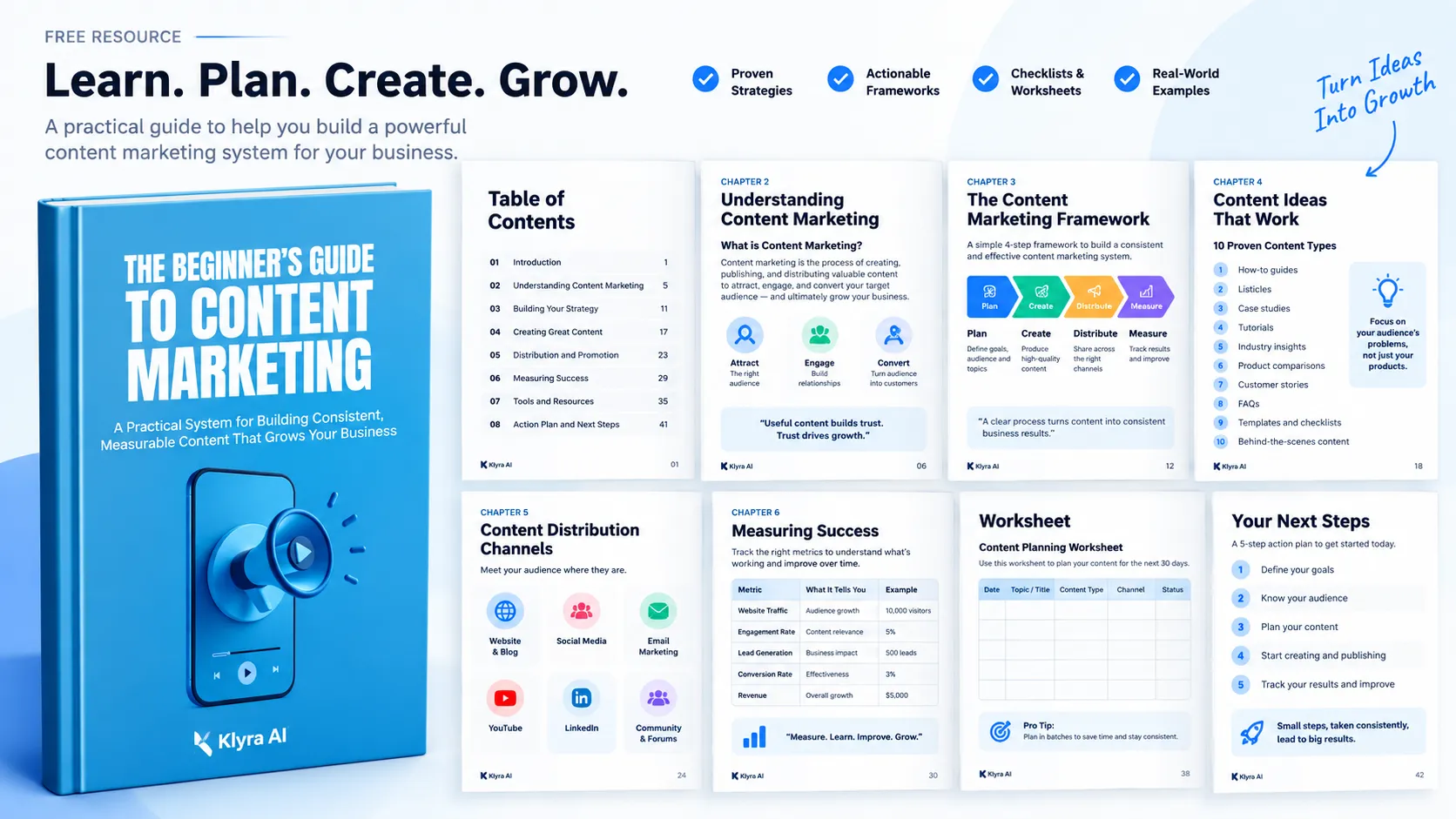
Content Marketing as a Strategic Business Asset
Content marketing does not have to mean publishing constantly or trying to appear on every platform. The resource begins with a simpler idea: create useful information that helps people solve real problems and naturally brings them closer to a business.
The difference is between treating content as a series of temporary posts and treating it as a strategic asset. Random publishing often means creating whenever inspiration appears, without a defined goal, audience, or measurement system. This can lead to inconsistent publishing, wasted effort, unclear positioning, and difficulty understanding whether content is producing business results.
A strategic approach gives every piece of content a purpose. Content should be valuable to the audience, connected to a business goal, and measurable in its impact. Instead of optimizing only for likes, shares, or other surface-level activity, the focus shifts toward outcomes such as leads, sales, engagement, relationships, and actions.
Why Content Can Compound
The resource describes three forces that can make strategic content increasingly valuable over time.
- Evergreen traffic: Useful content can continue attracting visitors through search after publication.
- Lower acquisition effort: A content library can educate prospects before a sales conversation, helping them understand a business's approach and expertise.
- Intelligent repurposing: A well-researched core piece can become blog content, social posts, email sequences, presentations, audio, or other formats.
This creates an important shift in mindset. Content is not simply something to publish and move past. A useful content library can become a collection of assets that continue contributing value.
The Content Value Engine
The guide presents a four-stage value engine that moves people from discovering a business to taking meaningful action:
- Awareness: People discover the business through content such as blog posts, videos, and social content.
- Engagement: People interact with ideas through newsletters, webinars, comments, and other two-way experiences.
- Trust: Case studies, testimonials, and consistently useful content help establish credibility.
- Action: Prospects take steps such as starting a trial, requesting a consultation, or exploring a product demonstration.
Each stage creates different forms of value. Content captures attention, provides insight into what resonates with an audience, builds relationships through cumulative trust, and can contribute to revenue through content-influenced conversions.
The engine depends on three core inputs: understanding the audience, having clear business goals, and creating consistently. Measurement then creates the feedback loop. Results provide insights, insights influence future content, and future content becomes more effective as the system improves.
Start Measuring Before Revenue Appears
Beginners do not need to wait months before evaluating whether content is producing useful signals. The guide recommends watching early indicators such as email subscriptions, resource downloads, time on page, meaningful comments, direct messages, consultation requests, and social shares from engaged followers.
A simple starting measurement system can consist of website analytics, a basic spreadsheet, and one clearly defined business goal. Before creating new content, record baseline numbers such as website visitors, social followers, email subscribers, and average leads or sales. Then establish one achievable 30-day target connected to the business.
Know, Love, Serve Your Audience
Effective content begins with understanding the people it is intended to serve. Guessing what an audience wants can result in significant wasted effort. The guide recommends systematic listening instead.
Useful sources of audience insight include direct questions sent to existing contacts, social media discussions, product reviews, industry conversations, customer emails, support tickets, online communities, search suggestions, video comments, and quick customer polls.
Demographic and Psychographic Insights
Demographic information can help determine how content should be packaged. Information such as age, location, income, and job title can influence channel selection, visual presentation, and examples.
Psychographic information helps determine what the content should actually address. Values, frustrations, goals, and fears can influence topic selection, messaging angles, and calls to action.
The guide emphasizes that both matter, but understanding motivations and frustrations can reveal deeper content opportunities.
Build an Evidence-Based Persona
A useful persona should be based on evidence rather than imagination. One detailed profile grounded in real audience information can be more useful than numerous vague personas.
A practical persona can include a snapshot of the person, their goals, frustrations, content habits, and purchase triggers. Each element should help make an actual content decision. Irrelevant personal details should not be included simply to make the persona appear more detailed.
Use an Empathy Map
An empathy map adds another layer of understanding by organizing what the audience says, thinks, does, and feels. Looking at these four areas can reveal differences between public statements and private concerns.
Patterns from the empathy map can become content themes. If time pressure repeatedly appears as a concern, for example, it can become a broader content focus. The preferred formats of the audience should also influence how those themes are packaged.
Prioritize Ideas with the Serve Score
The resource introduces a simple prioritization formula:
(Impact × Relevance) ÷ Effort = Serve Score
Impact and relevance are scored from 1 to 10, as is effort. A topic that is highly relevant and impactful but requires relatively little effort receives a stronger score. This provides a more objective way to prioritize content instead of simply choosing whatever idea happens to be most exciting at the moment.
Build a Blueprint for Consistency
Once audience needs are understood, the next challenge is turning those insights into a system that can actually be maintained.
The guide identifies four components of consistent creation: clear goals, thematic focus, calendar planning, and a realistic workflow.
Turn Business Objectives into Content Goals
Broad goals such as increasing awareness or engagement are difficult to use when deciding what to publish. Instead, translate business objectives into one to three SMART content goals: specific, measurable, achievable, relevant, and time-bound.
For example, a business seeking more service revenue might create content specifically intended to generate qualified leads and track consultation requests. A business launching a product might focus on building a pre-launch list and measure sign-ups.
Establish baseline measurements before starting, then review performance regularly. The guide recommends reviewing metrics against targets on a recurring basis so that goals remain connected to actual decisions.
Create Content Pillars and Themes
Based on audience research, identify three or four broad content pillars that answer the audience's core questions. These pillars become ongoing areas of expertise.
Then turn those pillars into time-bound monthly or quarterly themes. This creates a connected body of content instead of a collection of unrelated pieces.
Content should also cover the full awareness-to-action journey. Educational content can create awareness, downloadable resources can encourage engagement, case studies can build trust, and demonstrations or other action-oriented content can help move prospects forward.
Choose a Sustainable Publishing Cadence
Quality matters more than creating an ambitious schedule that cannot be maintained. A realistic cadence is more valuable than periods of intense publishing followed by long gaps.
A simple editorial calendar can track the publish date, theme, format, call to action, and status. A spreadsheet can be sufficient for a solo operator, while teams may benefit from collaboration tools.
A content bank can also protect momentum when schedules become disrupted. Store overflow ideas and partially developed outlines so that there is always material available to complete.
Use Story, Voice, and Format Strategically
Good content is not only about what information is presented. The guide connects story, brand voice, and format to the effectiveness of the overall content system.
Build Stories Around Transformation
The resource explains that effective stories generally involve a relatable character, a clear challenge, a resolution, and a visible transformation. It recommends the simple ICE check when reviewing a story:
- Is it clear enough for a 12-year-old to understand?
- Does it stir an emotion?
- Does it show empathy for real challenges?
The guide also presents five story frameworks that small businesses can adapt: before-after-bridge, problem-agitate-solution, a simplified hero's journey, customer spotlight, and contrast stories.
Develop a Consistent Brand Voice
Brand voice is the consistent personality expressed through content, while tone adapts that personality to different situations.
The resource recommends a three-step process for developing a voice:
- Values audit: Identify the business's most important values.
- Adjective shortlist: Translate those values into qualities that describe how the brand communicates.
- Voice statement: Turn those qualities into a concise description of the communication approach.
A documented voice guide can make content creation more consistent, particularly when multiple people contribute. The guide also recommends maintaining simple do-and-don't rules, testing content by reading it aloud, and documenting successful phrases as reference points.
Choose Formats Based on the Audience
Format selection should consider audience preferences, business goals, and production capacity. Instead of trying to create everything, the resource recommends a one core-two support approach: choose one primary format and two secondary formats that can support repurposing.
Blogs may support awareness and trust, newsletters may support engagement and action, short videos can support engagement, longer videos can support trust, podcasts can support relationships, and social posts can support awareness and reminders.
Amplify the Signal Through Distribution
Creating valuable content is only part of the process. Distribution determines whether people can actually find and engage with it.
Prioritize Owned Channels
The guide identifies websites, email lists, and podcast feeds as owned channels because the business has direct control over them. Before relying heavily on social platforms, establish a distribution foundation on channels you control.
A simple promotional sequence can include featuring new content on the website, sending an email, adding it to a resource library, and including it in an email signature. Existing high-traffic content can also link contextually to new resources.
Use a Core-and-Satellite Channel Strategy
The guide introduces the 3-2-1 rule: publish three times weekly on a primary channel, twice on a secondary platform, and once on an experimental channel.
The purpose is not to be everywhere. Channel selection should reflect actual audience behavior. The resource distinguishes between owned media, earned media such as guest posts and interviews, shared media such as social platforms and forums, and paid media such as boosted posts and advertising.
Repurpose One Core Asset
A core piece of content can become multiple derivative assets. A workshop recap, for example, can become a detailed article, social carousel posts, visual quotes, a podcast episode, a transcript, a downloadable checklist, and an email sequence.
This approach allows one research effort to serve different learning preferences and distribution channels.
A repurposing workflow can be managed with simple status stages such as source content, in-design, scheduled, and published. The guide also recommends selecting two or three extension formats for each core piece based on audience preferences and priority channels.
Use Basic SEO and Partnerships
The resource recommends matching keywords to search intent, writing descriptive and benefit-focused titles, adding natural-language alt text to images, and using internal links to connect relevant content.
It also highlights backlinks and collaborations as ways to expand reach. Potential approaches include guest posts, podcast appearances, testimonials for tools genuinely used, newsletter mentions, joint social sessions, and complementary lead magnets.
Measure What Actually Matters
Measurement should support decisions rather than create a large collection of numbers that do not change what you do next.
Separate Vanity Metrics from Value Metrics
Vanity metrics can look impressive without providing useful direction. Value metrics help determine what to create, change, or stop.
The guide recommends focusing on three broad measurement areas: traffic quality, engagement depth, and conversion efficiency.
Different stages of the value engine require different measurements. Awareness can include unique visitors and traffic sources. Engagement can include time on page, bounce rate, pages per session, and email open rates. Trust can include returning visitors, content shares, comment quality, and time in the funnel. Action can include CTA click-through rates, lead form completions, consultation bookings, and sales attributed to content.
Build a Simple Dashboard
A basic measurement system can use Google Analytics 4, Google Looker Studio, native social analytics, and a spreadsheet for manually tracked information.
The guide recommends organizing the dashboard around four areas: traffic, engagement, leads, and revenue influence. A short weekly review and a deeper monthly review can provide a regular rhythm without creating unnecessary reporting work.
Turn Data into Decisions
The guide's three-step insight loop is:
- Observe: Identify meaningful patterns in the data.
- Diagnose: Determine possible reasons for the pattern.
- Act: Test a targeted improvement.
Trends are more useful than isolated data points. Looking across four-week and 90-day periods can help distinguish temporary fluctuations from meaningful changes.
The guide also provides a simple ROI calculation using conversion rate multiplied by lead value. The broader principle is that measurement should lead directly to action. If traffic is high but engagement is low, investigate audience alignment or the content's ability to deliver on its promise. If engagement is strong but conversions are weak, examine the calls to action and the path toward action.
Iterate, Audit, and Scale
Content marketing is not a set-and-forget activity. Content can lose relevance, workflows can become inefficient, and audience needs can change.
Run Regular Content Audits
A content audit systematically identifies what is working, what needs updating, and what should be retired.
The guide recommends a lightweight audit every six months. Export the content inventory, categorize pieces by goal and value-engine stage, gather performance data, decide whether each asset should be kept, refreshed, merged, or retired, and schedule the resulting actions.
Use A/B Testing Carefully
A/B testing can help improve individual content elements. Start with a hypothesis, change one element, and compare the original with the modified version.
The guide identifies headlines, email subject lines, featured images, and calls to action as examples of elements that can have significant impact. It also emphasizes having enough data before drawing conclusions and avoiding simultaneous changes that make it difficult to determine what caused the result.
Improve the Workflow
Workflow mapping can reveal where time is being lost between idea generation and publication. Common bottlenecks can include image creation, final editing, and technical publishing.
Batching similar tasks can reduce context switching. The guide also recommends documenting repetitive processes with simple standard operating procedures and creating reusable templates for formats such as blog posts, newsletters, and social carousels.
Automate Without Losing Authenticity
Automation can support repetitive activities such as welcome email sequences, evergreen social queues, publishing workflows, KPI emails, meeting-booking sequences, and reminders to refresh older content.
However, the resource cautions against automating so much that the human voice disappears. Automated content should be reviewed periodically to ensure it still reflects the current brand, positioning, offerings, and communication style.
When delegating, begin with structured but time-consuming activities such as repurposing, basic design, and scheduling. Clear voice guardrails should include example phrases, expressions to avoid, examples that represent the desired voice, and an approval process.
Build the Content-Momentum Flywheel
The final section connects the entire system into a continuous loop. Audience understanding informs planning. Planning informs creation. Stories, voice, and formats shape the content. Distribution increases its reach. Measurement reveals what worked. Audits and testing identify improvements. Better systems make the next cycle easier.
This is the content-momentum flywheel: each cycle provides information and assets that can strengthen the next cycle.
Move from Funnel to Loop
Traditional marketing can view customers as moving through a narrowing funnel. The resource instead presents content as an ongoing cycle in which each stage strengthens the next.
For example, stronger engagement can produce better audience data. Better audience data can lead to more relevant content. More relevant content can improve engagement again. This creates momentum rather than requiring the business to restart its marketing process each time.
Overcome Common Plateaus
Creative blocks can be addressed by maintaining a file of ideas, batching work during periods of higher energy, scheduling breaks, participating in creator communities, and recognizing small wins.
Platform changes are another potential challenge. The guide uses this to reinforce the importance of owned channels such as websites and email lists, which provide a more direct connection with the audience.
When growth stalls, diagnose the specific bottleneck. A content audit, a new call-to-action test, or refreshed audience research may reveal a more appropriate intervention than abandoning the entire strategy.
Your Next 90 Days
The resource closes with a practical 90-day growth plan. Begin with one specific target and a deadline. Break the goal into monthly themes connected to established content pillars. Use the first part of the cycle for audience research, the middle for creation, and the final part for measurement and adjustment.
Use a tiered review system: quick weekly checks for early signals, monthly reviews for conversion and deeper performance analysis, and periodic audits of the broader content library.
The central lesson is not perfect execution. It is persistent iteration. A sustainable content system becomes stronger when audience insight, purposeful creation, distribution, measurement, and improvement are connected into one continuous process.
For someone starting with content marketing, the practical starting point is straightforward: define one SMART goal, understand the audience, establish a small number of content pillars, choose a sustainable publishing rhythm, create content with a clear purpose, distribute it deliberately, measure meaningful outcomes, and use those findings to improve the next cycle.