Blogs / AI as a Research Assistant, Not a Decision Maker
AI as a Research Assistant, Not a Decision Maker
Klyra AI / February 3, 2026
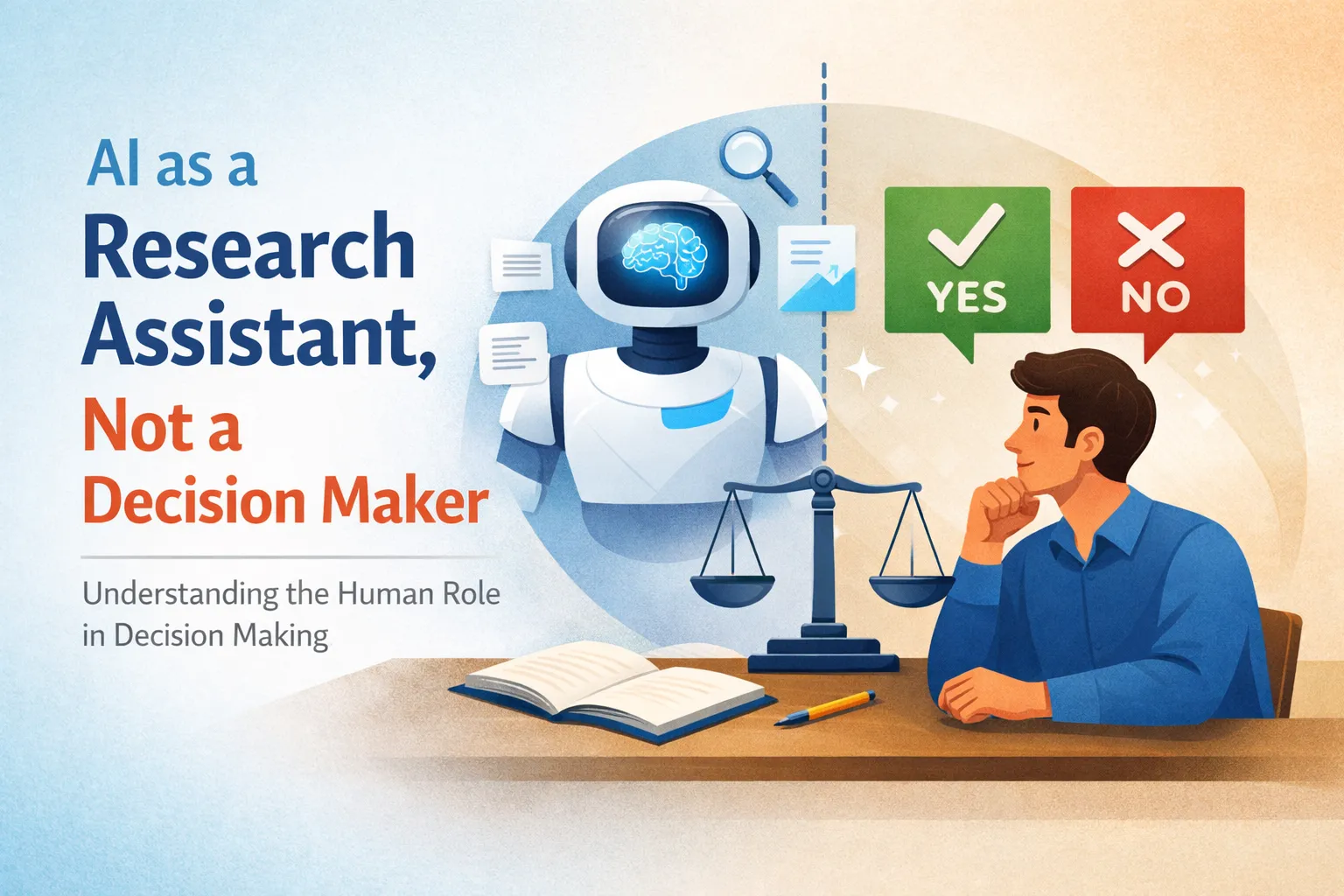
AI is increasingly fluent, confident, and persuasive.
It can summarize reports, compare options, surface insights, and even recommend next steps. For many professionals, this creates a tempting question.
If AI can research so effectively, why not let it decide?
The answer is simple but often overlooked. Research and decision-making are not the same activity. AI excels at one and struggles fundamentally with the other.
Understanding this boundary is critical for using AI responsibly and effectively.
Why AI Feels Like a Good Decision Maker
AI produces answers quickly and with confidence. Its responses are structured, articulate, and often supported by reasoning that appears coherent.
This creates an illusion of judgment.
In reality, AI is synthesizing patterns from existing information. It does not understand consequences. It does not hold values. It does not bear responsibility.
The fluency of AI output can obscure this limitation, especially in high-pressure environments where speed is prioritized over reflection.
The Fundamental Difference Between Research and Decisions
Research is about gathering and organizing information. Decisions are about choosing under uncertainty.
AI is well suited to research tasks because they rely on recall, pattern recognition, and synthesis. These are computational strengths.
Decisions require context, trade-offs, accountability, and ethical judgment. These depend on human experience and responsibility.
Conflating these roles leads to overreliance on AI in situations where its confidence exceeds its competence.
Where AI Adds Maximum Value in Research Workflows
AI is exceptionally effective at expanding the information landscape.
It can surface relevant sources, summarize large documents, identify themes across datasets, and explore multiple perspectives quickly.
This reduces cognitive load and accelerates understanding. Professionals move faster from ignorance to informed awareness.
When used as a research assistant, AI amplifies human capability without replacing human judgment.
The Risks of Delegating Decisions to AI
Delegating decisions to AI introduces risks that are not immediately visible.
AI does not know what information is missing. It cannot recognize when assumptions are invalid or when stakes are unusually high.
Errors in AI-generated decisions often appear reasonable until consequences emerge. At that point, accountability becomes unclear.
When responsibility matters, delegation becomes abdication.
Why Accountability Cannot Be Automated
Every meaningful decision has consequences. Someone must own those consequences.
AI cannot be accountable. It cannot explain intent, justify trade-offs, or adapt values based on outcomes.
Organizations that rely on AI for decisions often discover this gap only after something goes wrong. At that moment, the lack of human ownership becomes a liability.
Accountability is not a technical feature. It is a human obligation.
The Role of Human Judgment in AI-Supported Research
Human judgment provides context that AI cannot infer reliably.
Professionals understand organizational constraints, stakeholder expectations, and situational nuance. They know when speed matters and when caution is required.
AI can inform judgment, but it cannot replace it. The most effective workflows place AI upstream, not at the point of commitment.
Designing Clear Boundaries for AI Use
Successful teams define boundaries explicitly.
AI is used to explore options, not select them. It prepares inputs, not outcomes. It supports reasoning, not authority.
Clear boundaries reduce risk and increase trust. They also prevent subtle dependency where human oversight gradually erodes.
Intentional design protects both performance and responsibility.
Why Overreliance Weakens Decision Quality Over Time
When AI answers too many questions, humans stop asking them.
Critical thinking declines. Domain expertise atrophies. Decisions become reactive rather than reflective.
This degradation is gradual and difficult to detect. By the time it becomes obvious, reversing it is costly.
Maintaining decision-making skills requires deliberate engagement, even when AI is available.
Evaluating AI Outputs Before Acting on Them
AI outputs should be treated as hypotheses, not conclusions.
They require verification, contextualization, and challenge. Professionals should ask what assumptions underlie the output and what information may be missing.
Tools like the SEO Performance Analyzer reinforce this mindset in content workflows by emphasizing evaluation over production. The same principle applies broadly. Outputs must be tested against reality.
What Research Says About AI and Decision Support
Research from organizations such as the Organisation for Economic Co-operation and Development consistently shows that AI performs best as a decision support system rather than an autonomous decision maker.
The strongest outcomes occur when humans retain control over goals, values, and final judgments, while AI assists with analysis and exploration.
This balance maximizes benefits while minimizing risk.
AI as a Force Multiplier, Not an Authority
AI multiplies what already exists.
In the hands of capable professionals, it accelerates insight. In the absence of judgment, it accelerates mistakes.
Treating AI as an authority misunderstands its role. Treating it as a force multiplier respects both its strengths and its limits.
Final Thought
AI is an extraordinary research assistant.
It can help professionals see more, learn faster, and consider alternatives they might otherwise miss.
But decisions shape outcomes, careers, and organizations. Those choices demand responsibility, context, and values.
AI can inform decisions. It should never replace the people who must live with them.